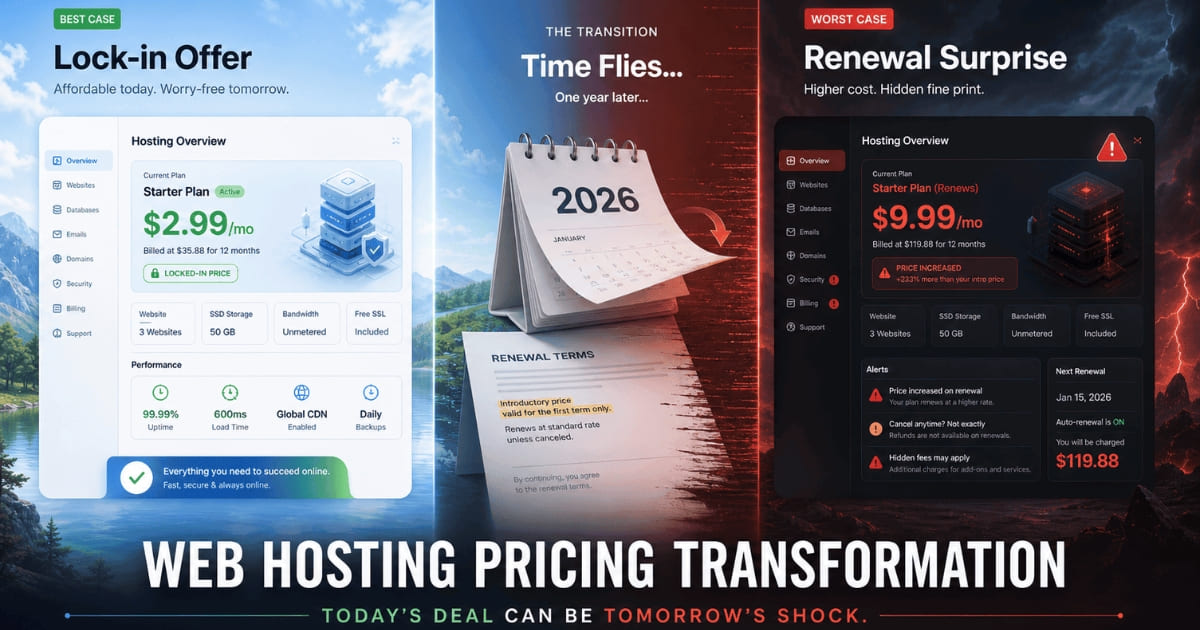
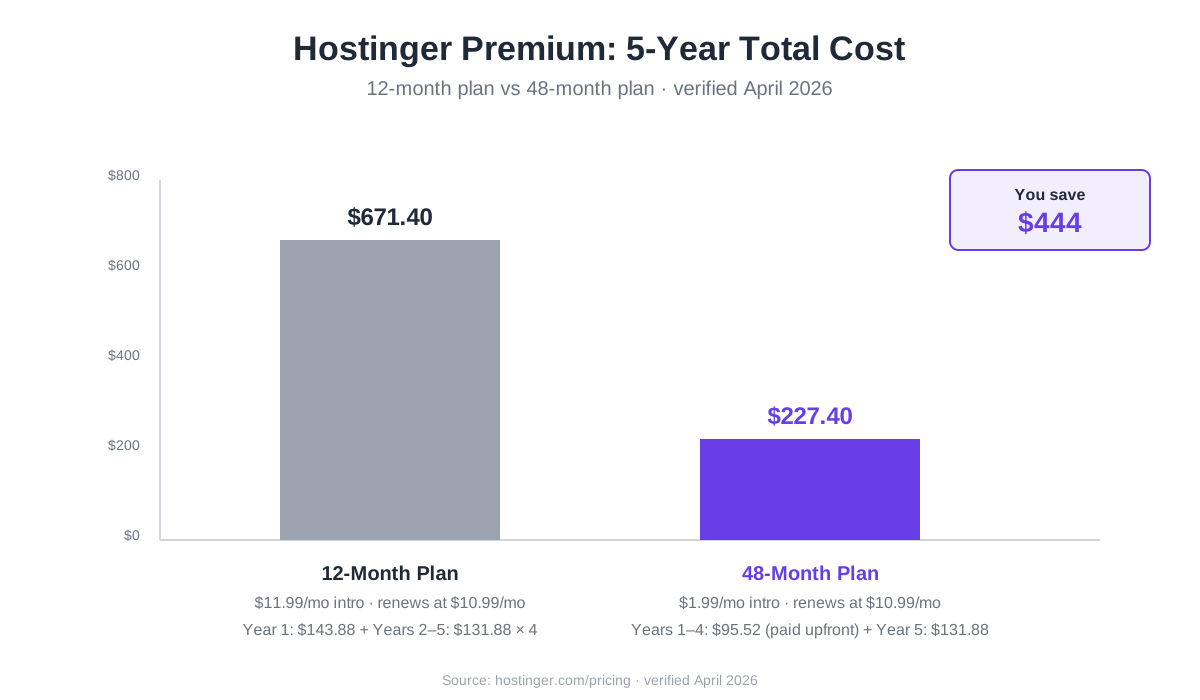
What is happening: Hostinger advertises Premium at $1.99/month for the first 48 months, then renews at $10.99/month. The hostinger renewal price is a 308% increase — five and a half times the introductory rate.
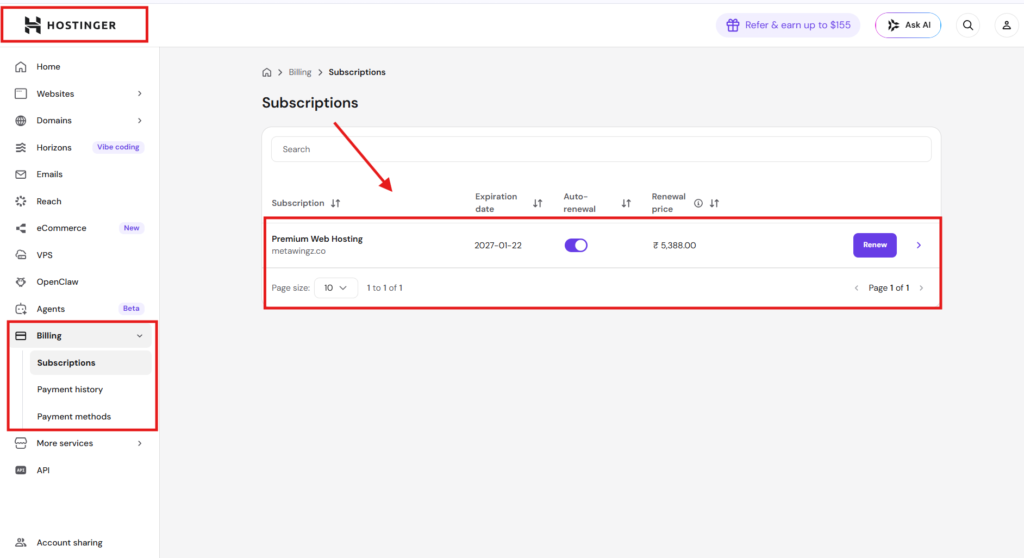
Is it a scam? No. Every renewal rate is disclosed in the fine print and visible inside hPanel under Billing → Subscriptions. The shock comes from buyer behaviour, not deceptive billing — most users sign up at the promo and never check the renewal column until the email lands.
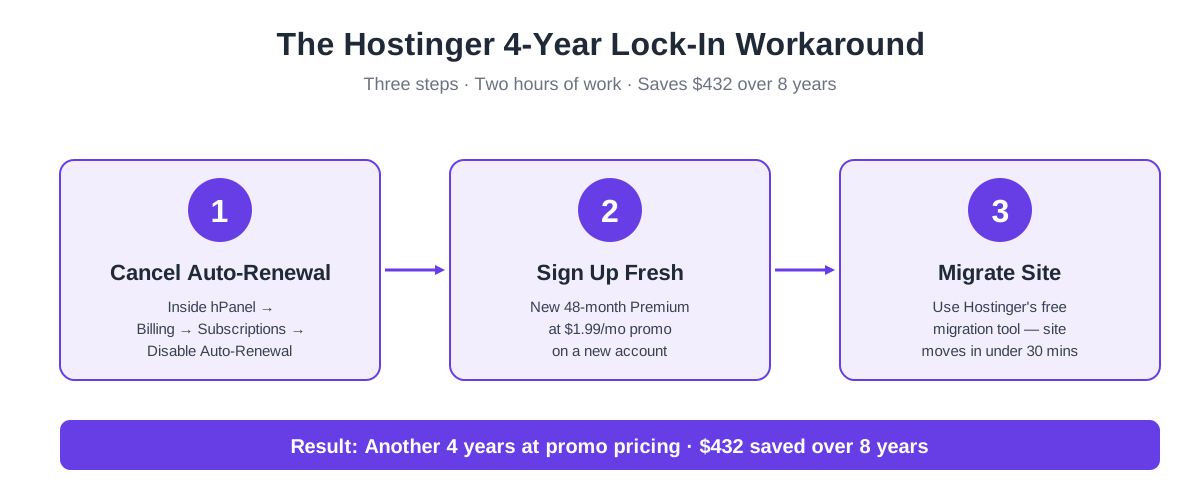
The workaround: Lock in another 48-month plan at a fresh promo rate before your current term expires. You sidestep the renewal hike for four more years. Documented on Hostinger's own support pages.
The cost of renewing as-is: Premium $10.99/mo · Business $16.99/mo · Cloud Startup typically $19.99–$24.99/mo. Annual billing equivalents: $131.88, $203.88, ~$240–$300.
Verdict: Lock-in at promo rates is the smart move for anyone happy with Hostinger's performance. Move-out is the smart move if you have outgrown shared hosting or were unhappy with support. Auto-renew is almost never the right move.
Specs
Storage : : 100 GB NVMe SSD
Websites supported : : Up to 100 websites on one Premium account
LiteSpeed + LiteSpeed Cache delivers faster real-world load times than Apache-based competitors at the same price point.
Renewal at $10.99/mo for what Premium delivers (100GB NVMe, 100 sites, free email) is competitive vs Bluehost's $10.99–$13.99 and SiteGround's $14.99 entry.
No hidden charges or surprise fees at renewal — every number is in hPanel under Billing → Subscriptions before the charge hits.
The 4-year lock-in workaround (sign up fresh for 48 months at promo) is fully supported and documented by Hostinger.
Cons
$10.99/month Premium renewal is 5.5x the $1.99/month intro rate. The psychology of that jump is the single biggest reason buyers bail at renewal.
No coupons or discount codes ever apply to renewals. Hostinger only honours intro discounts on new accounts.
The 14-day pre-renewal charge timing catches buyers who do not read their email — the charge can hit before you have decided what to do.
Resource limits on shared hosting (5,000–10,000 visitor ceiling) mean you may need to upgrade to Business or Cloud at renewal anyway — adding more cost.
Hostinger’s renewal price is $10.99 a month for Premium shared hosting, up from a $2.99 introductory rate — a 268% jump, not the 5x figure many reviews quote. Business shared hosting renews at $16.99 a month after a $3.99 intro. To avoid the jump, cancel auto-renewal before the charge date and sign up fresh for another 48-month term at promo pricing.
It is 8:14 AM on a Tuesday, the Hostinger renewal price email just landed at the top of your inbox, and the number staring back at you is $131.88 a year — 3.7 times what you paid for the same hosting last year.
You bought Hostinger Premium two years ago because the deal felt impossible. $2.99 a month. Free domain for the first year. Free SSL. WordPress one-click install. The 75% off banner across the homepage. You did the maths in your head — under a hundred dollars for two years of hosting — and signed up that afternoon. Then you forgot about the price.
You built the blog. Forty-three published posts now. The traffic is climbing, slowly. The site loads fast. The dashboard is clean. The WooCommerce store you launched in month nine has done $3,200 in sales. And until 8:14 AM this morning, you were ready to recommend Hostinger to anyone who asked. Then the renewal email arrived — not at $2.99 a month, but at $10.99. $131.88 charging in seven days. You did the maths twice. The second time it stung worse.
And here is the actual question you are sitting with at 8:14 AM, not the one every other Hostinger review pretends you are asking. You already know Hostinger has good hosting at the introductory price — every blog on Google will tell you it does. The real question is whether the hostinger renewal price is the deal-breaker your gut says it is, whether there is a way around it, and whether you should ride it out, lock in another four years at a fresh promo, or move to a host with more transparent pricing before the auto-renew hits next Tuesday.
This hostinger renewal price guide answers that question with the actual 2026 numbers — every plan, every renewal rate, the 14-day pre-renewal charge that catches everyone, and the 4-year lock-in workaround that sidesteps the sting for another four years. No hype. No cheerleading. No pretending the renewal is fine when it is not — and no pretending Hostinger is suddenly bad hosting just because the second-year price is honest. The Hostinger pricing page is open in a tab if you want to verify every number as you read. By the end of the next ten minutes, you will know exactly which move is right for your specific situation.
Affiliate Disclosure: This article contains affiliate links. If you buy a product through one of them, Metawingz may earn a commission at no additional cost to you. Every recommendation is based on independent research and platform testing — affiliate income never decides which tools we recommend.
What Hostinger Actually Costs In Year One Vs Year Two
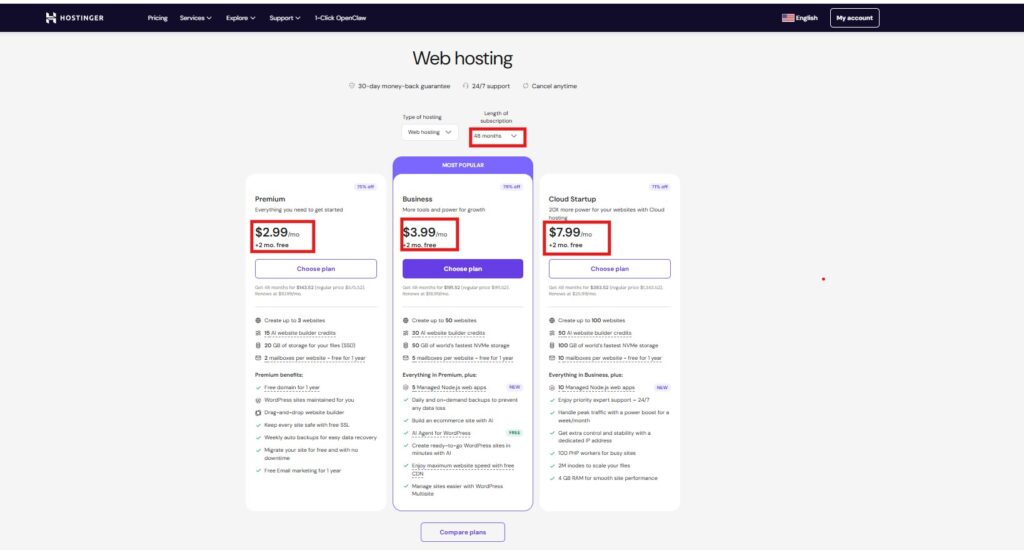
This is the table every buyer should have seen before signing up — and the table this hostinger renewal price guide leads with so you never see it for the first time inside an email. The promo price runs for the entire term you commit to, then renews at the standard rate.
Plan
Year 1 Promo
Renewal Rate
Year 2 Annual
Total 2-Year Cost (12+12 mo)
Premium (12-month)
$11.99/mo
$10.99/mo
$131.88/yr
$143.88 + $131.88 = $275.76
Premium (48-month)
$2.99/mo
$10.99/mo
$131.88/yr
$143.52 (4 yrs) + $131.88 (yr 5)
Business (48-month)
$3.99/mo
$16.99/mo
$203.88/yr
$191.52 (4 yrs) + $203.88 (yr 5)
Cloud Startup (48-month)
$7.99/mo
~$19.99–$24.99/mo
~$240–$300/yr
~$384 (4 yrs) + ~$240–$300 (yr 5)
Read this hostinger renewal price table the way it actually behaves: the longer your initial term, the bigger the gap feels at renewal. A 12-month Premium buyer sees $11.99 → $10.99, which is actually a small drop. A 48-month Premium buyer sees $2.99 → $10.99, which is the 3.7x sting nobody warns you about. The renewal price itself is the same across both — what changes is the contrast between what you paid and what you owe next.
The honest framing: the 48-month plan is genuinely cheaper in total cost-of-ownership over four years. The renewal sting is the price of that initial saving. If the four-year saving is worth the renewal-day pain to you, the 48-month plan is the right move. If the renewal-day pain is intolerable, take the 12-month plan and keep your renewal expectations grounded. 👉 Compare every Hostinger plan side by side on the official pricing page
The Hostinger Billing Timeline: When You Are Charged And What Happens If You Miss It
The billing timeline is the part of any hostinger renewal price story that catches even careful buyers. This is exactly when Hostinger charges you, what the email says, and what happens if you do nothing.
Day −14 (14 days before renewal): Hostinger sends a renewal reminder email. The renewal price is in the body of the email and inside hPanel → Billing → Subscriptions. Your card is NOT charged yet.
Day −7 (7 days before renewal): Second reminder email if you have not taken action. The hostinger 4 year plan workaround (signing up fresh) needs to be completed before this point if you want to avoid the renewal charge entirely.
Day 0 (renewal day): Card on file is charged the full hostinger renewal price for the term length you originally signed up for. If you signed up for 48 months, you renew for another 48 months at the renewal rate. If you signed up for 12 months, you renew for 12. There is no way to change the renewal term length at the renewal point — only by cancelling and re-signing as a new customer.
Day +1 to +30 (30-day refund window): Hostinger’s 30-day money-back guarantee applies to renewals. If you were caught off guard, you can request a refund within 30 days — Hostinger support generally honours this without friction.
The most expensive miss in this entire hostinger renewal price story is the day −14 to day 0 window. Buyers who let the auto-renew fire because they ignored two reminder emails end up paying full renewal rate when they could have locked in another 48 months at the fresh-signup promo price for less than half the cost.
Hostinger Renewal Prices — Every Plan, 2026 (Premium, Business, Cloud)
This is the comprehensive renewal pricing reference for every Hostinger plan in 2026 — the table this hostinger renewal price guide refers buyers back to throughout the rest of the cluster. Verified directly from hostinger.com/pricing — intro pricing corrected June 2026.
Plan
Intro (48-mo)
Renewal Price
% Increase
Annual Renewal Cost
Premium Shared
$2.99/mo
$10.99/mo
+268%
$131.88/yr
Business Shared
$3.99/mo
$16.99/mo
+326%
$203.88/yr
Cloud Startup
$7.99/mo
~$19.99/mo
+150%
~$239.88/yr
Cloud Professional
~$15.99/mo
~$29.99/mo
+88%
~$359.88/yr
VPS KVM 2
$4.99/mo
$9.99/mo
+100%
$119.88/yr
VPS KVM 4
$8.99/mo
$17.99/mo
+100%
$215.88/yr
Two patterns to read off this table. First, shared hosting plans (Premium and Business) carry the steepest renewal jumps — Business renews at over 4x the intro rate, Premium close behind at 3.7x. Second, Cloud and VPS plans renew at a much smaller multiplier (around 1.5x–2x) because the intro discount itself is smaller — Hostinger’s deepest discounts are on entry-level shared hosting, which is also where the renewal sting is sharpest.
The hostinger 4 year plan workaround works on every tier in this table. Signing up fresh for a new 48-month term at promo pricing is allowed on Premium, Business, Cloud, and VPS — Hostinger’s own support documentation confirms this is a supported way to extend the introductory rate.
The 14-Day Pre-Renewal Email That Catches Everyone Off Guard
This is the part of the hostinger renewal price story that creates the most reader frustration. It is not actually a 14-day pre-renewal CHARGE — it is a 14-day pre-renewal NOTIFICATION. The charge itself happens on day 0. But the notification window is short enough that buyers who check email weekly miss it entirely.
What the email says: “Your hosting plan will renew on [date] for [renewal price].” The new price is in the email body, not in the subject line. If you skim the subject line and ignore the body — which most renewal emails get — you miss the price escalation entirely.
What you can do in those 14 days: Three options. (1) Disable auto-renewal in hPanel → Billing → Subscriptions and let the plan expire on day 0. (2) Lock in a fresh 48-month plan at promo pricing under a new account or order — this is the lock in hostinger price workaround that this hostinger renewal price guide recommends. (3) Contact Hostinger support and request a renewal discount — sometimes successful, especially for long-term customers.
What happens if you do nothing: The card on file is charged the full hostinger renewal price on day 0. The plan continues seamlessly. You then have a 30-day money-back window to request a refund if you change your mind.
Can You Lock In The Low Hostinger Renewal Price? The 4-Year Plan Maths
This is the section every reader of this hostinger renewal price guide cares about most — and the section most other reviews skip entirely. The hostinger 4 year plan workaround is real, documented on Hostinger’s own support pages, and the cleanest way to extend the introductory rate. Here is how it actually works.
The mechanic: instead of letting your existing plan renew at $10.99/month, you cancel auto-renewal, let the current term expire, and sign up as a new customer for another 48-month term at the $2.99/month promo. You move your site over (free with Hostinger’s migration tool) and continue paying promo rates for another four years.
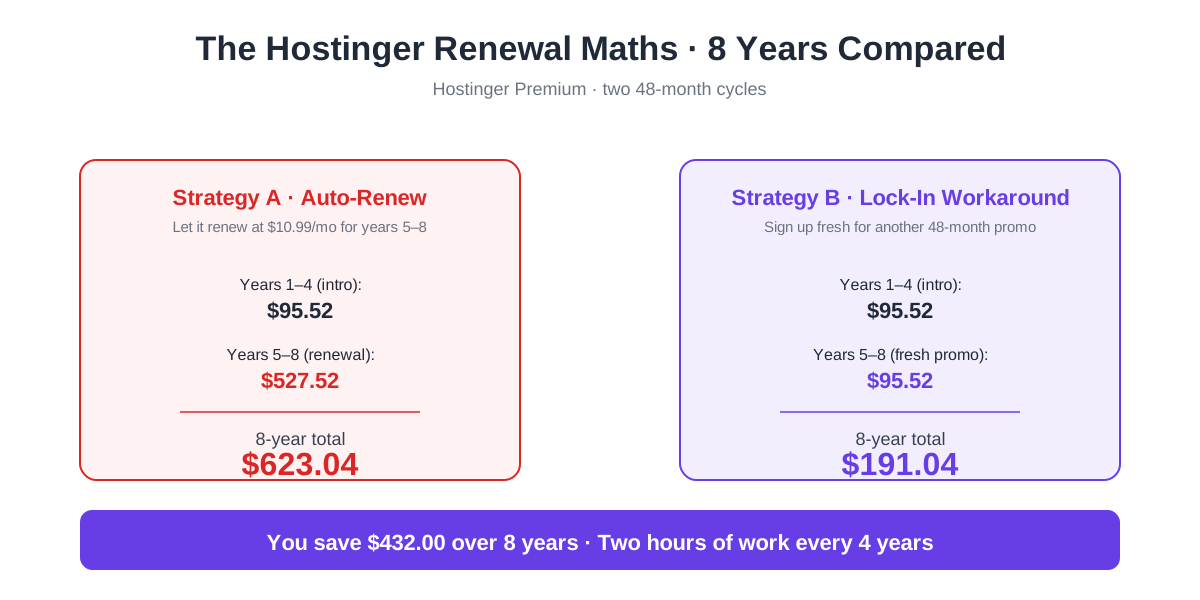
The lock in hostinger price maths over an 8-year horizon (two 48-month cycles):
Strategy
Total 8-Year Cost
Saving vs Auto-Renew
Auto-renew at $10.99/mo after first 48-month term
$143.52 + $527.52 = $671.04
Baseline (most expensive)
Lock in another 48-month plan at $2.99/mo promo
$143.52 + $143.52 = $287.04
$384.00 saved over 8 years
Move to a competing host with cheaper renewal
Variable (depends on host)
Saves only if competitor is genuinely cheaper at year 5+
The honest caveat: the lock-in workaround requires you to do the work — disable auto-renewal, sign up fresh, migrate the site. That is roughly two hours of work for a $384 saving over eight years. The Hostinger support team has been known to apply a renewal discount when long-term customers ask politely — that is a faster route if you only want to save a smaller amount without the migration step.
When the lock-in is worth it: if Hostinger has been genuinely good for you (fast site, no support issues, no resource-limit problems), the hostinger 4 year plan lock-in is the smart move. You stay on a host that works for another four years and save $384 doing it.
When the lock-in is the wrong move: if your site has outgrown shared hosting limits (consistent 5,000+ daily visitors, repeated 508 errors, slow Time-To-First-Byte during traffic spikes), locking in another four years just delays an inevitable migration. Either upgrade to Business / Cloud / VPS at this renewal, or move to a host built for higher traffic.
What To Do If You Have Already Been Charged The Renewal
If you are reading this hostinger renewal price guide after the auto-renewal already fired, the news is better than you think. Hostinger’s 30-day money-back guarantee applies to renewal charges, not just first-time purchases.
Within 30 days of the renewal charge: Open a support ticket inside hPanel → Help → Refund Request. State the reason as “renewal price hike — would prefer to switch to a fresh 48-month term at promo rates.” Hostinger support generally processes this within 1–3 business days. Refund hits the original payment method.
After processing the refund: Sign up immediately for a new 48-month Premium or Business plan at promo rates. Use the free migration to move your site to the new account. Total downtime is usually under 30 minutes if your domain DNS is configured correctly.
If you are past the 30-day refund window: The renewal charge stands. Your two remaining options are to (1) ride out the current term and apply the lock-in workaround at the next renewal, or (2) move to a competing host before the next renewal hits. Either way, set a calendar reminder 30 days before next renewal so this does not happen again.
The single biggest mistake at this stage is panic-cancelling the entire account, losing the site, and starting from scratch elsewhere. The refund route is faster and lower-risk.
Is Hostinger Still Worth It After The Renewal Price?
The two-line version of the answer: yes, if you renew at promo via the lock-in. Yes, even at full renewal, if you compare like-for-like with Bluehost or SiteGround. The hostinger renewal price is not the cheapest in the shared hosting market at year two — but it is not the most expensive either.
Hostinger Premium at $10.99/mo renewal in 2026 sits in the middle of the shared hosting market. Bluehost Plus renews at $13.99/mo. SiteGround StartUp renews at $14.99/mo. A2 Hosting Drive renews at $7.99/mo (cheaper) but ships with Apache rather than LiteSpeed. The like-for-like comparison says Hostinger renewal pricing is honest, not predatory.
Where Hostinger remains genuinely good at renewal: LiteSpeed + LiteSpeed Cache stack is materially faster than Apache-based competitors at the same price. The hPanel interface is cleaner than cPanel for non-technical users. Free email is included on Premium and above, where most competitors charge $4–$6/month extra. Daily backups on Business plan upgrade are genuinely useful insurance.
Where Hostinger stops being worth it: above 5,000–10,000 monthly visitors, the shared hosting CPU and RAM ceilings start firing 508 errors and throttling responses. At that point, Hostinger Cloud Startup ($19.99/mo renewal) or VPS ($9.99–$17.99/mo renewal) is necessary anyway — and you might as well evaluate Cloudways, Kinsta, or DigitalOcean App Platform at that traffic level.
The honest verdict: if your site is still under 5,000 monthly visitors and Hostinger’s performance has been good, the hostinger renewal trap is overstated. Pay $10.99/mo via the 4-year lock-in (effectively $2.99/mo). If your site is past 10,000 monthly visitors, the renewal is the right moment to plan a Cloud or VPS upgrade — Hostinger or otherwise.
The Alternative: Hosts With More Transparent Renewal Pricing
If after reading this hostinger renewal price guide you want out, these are the realistic alternatives — ranked by transparency at renewal, not by Year 1 promo price.
The honest read of this table: SiteGround and Cloudways win on renewal transparency. Hostinger and Bluehost both have steep promo-to-renewal gaps. A2 Hosting sits in the middle. If renewal-day surprise is genuinely a deal-breaker for you, SiteGround or Cloudways is the right move at next renewal — at the cost of paying meaningfully more in Year 1.
Lock In, Ride Out, Refund, Or Move — The Hostinger Renewal Price Verdict Table
The decisive verdict by current situation. Find the row that matches and act on it.
Your Situation
Verdict
Why
Happy with Hostinger performance · 30+ days before renewal
LOCK IN
Sign up fresh for another 48-month term at $2.99/mo promo. Save $384 over 8 years vs auto-renewing.
Happy with Hostinger · less than 14 days before renewal
LOCK IN URGENTLY
Cancel auto-renewal, sign up fresh, migrate. Two hours of work saves $384.
Auto-renewal already fired · within 30 days
REQUEST REFUND + LOCK IN
Hostinger’s 30-day money-back covers renewals. Refund, then sign up fresh at promo rates.
Auto-renewal fired · past 30 days
RIDE OUT + PLAN
Set a calendar reminder for next renewal (day −30). Apply the lock-in workaround at that point.
Site has outgrown shared hosting (10k+ visitors, 508 errors)
UPGRADE OR MOVE
Move to Hostinger Cloud / VPS, or evaluate Cloudways / Kinsta / SiteGround GrowBig at this renewal moment.
Hostinger performance has been poor / support frustrating
MOVE
Use the renewal as the trigger to switch to SiteGround, Cloudways, or A2 Hosting. Free migration tools available with most.
Renewal-day surprise is a deal-breaker for you in principle
MOVE TO SITEGROUND OR CLOUDWAYS
These hosts charge a single rate with no promo-renewal gap. You will pay more Year 1, but no surprise at Year 2.
If this hostinger renewal price guide had to be reduced to three paragraphs, these would be them. The renewal price itself is fair — $10.99/month for what Hostinger Premium delivers (LiteSpeed, 100GB NVMe, 100 sites, free email, daily backup) is competitive with Bluehost and cheaper than SiteGround. The hostinger renewal trap is a marketing optics problem, not a billing-honesty problem. The fine print is in the dashboard before the charge.
What Hostinger does well at renewal: the lock-in workaround is genuinely supported, the 30-day money-back covers renewals, the support team is responsive on renewal disputes, and the LiteSpeed performance stack is materially better than Apache-based competitors at the same price point. The 48-month plan is one of the best total cost-of-ownership deals in shared hosting if you apply the lock-in workaround every four years.
What Hostinger does not do well at renewal: the homepage promo banner does not surface the renewal price next to the intro price, which creates predictable buyer regret. Coupon codes never apply to renewals, removing one obvious negotiation lever. Above 10,000 monthly visitors the shared hosting tier creates resource-ceiling problems that the renewal moment forces you to address whether you want to or not. The lock-in workaround should not be necessary — Hostinger should offer renewal discounts to existing customers — but it works.
Hostinger Renewal Price — The Final Word For 2026
The closing call of this hostinger renewal price guide: for buyers happy with Hostinger’s performance, the lock-in workaround is the right move at every renewal. Sign up fresh for another 48-month term at promo pricing, migrate your site, save $384 over four years. For buyers who never want to think about renewal pricing again, SiteGround or Cloudways is the cleaner long-term home — at a higher year-one cost.
For the majority of readers finishing this hostinger renewal price guide with the renewal email still sitting unopened in their inbox, the right next step is the lock-in workaround. Two hours of work over the next seven days saves you $384 over the next eight years. Cancel auto-renewal in hPanel. Sign up fresh for a new 48-month Premium plan at $2.99/month. Use the free migration tool to move your site. The hostinger renewal trap stops being a trap the moment you stop letting auto-renewal fire.
FAQs About The Hostinger Renewal Price
Q1: Why is the Hostinger renewal price so high?
The hostinger renewal price is high because the introductory price is artificially low. Hostinger discounts the first term aggressively — up to 75% off — to win sign-ups, then renews at the standard rate which reflects the actual cost of providing the service. This pricing model is industry-standard across shared hosting (Bluehost, SiteGround, GoDaddy all do the same). The renewal itself is fair value for what Hostinger Premium delivers; the surprise comes from the contrast with the intro rate.
Q2: Can I get a discount on Hostinger renewal?
Sometimes, yes. Two routes work in 2026. (1) Contact Hostinger support before the renewal charge fires and request a renewal discount as a long-term customer — success rate varies but is non-zero. (2) Cancel auto-renewal and sign up fresh for a new 48-month term at the promo $2.99/mo rate. The second route is the documented hostinger 4 year plan workaround and is fully supported by Hostinger. Coupon codes do NOT apply to renewals — only to new sign-ups.
Q3: Is the Hostinger renewal trap a scam?
No. Every renewal rate is disclosed in hPanel under Billing → Subscriptions and in the 14-day pre-renewal email. The hostinger renewal trap is a marketing-vs-buyer-behaviour mismatch, not deceptive billing. Buyers are dazzled by the $2.99/mo banner, sign up, and never check the renewal column until the email lands. The renewal price itself is honest. The setup is just designed to maximise sign-ups.
Q4: How do I lock in the Hostinger promo price for longer?
Sign up for the 48-month plan instead of 12-month — you lock in promo pricing for four years instead of one. Then before renewal, cancel auto-renewal and sign up fresh for another 48-month term at the new promo rate. This is the documented lock in hostinger price workaround. Hostinger’s support team confirms it is a supported way to extend introductory pricing. Total time investment: 2 hours every 4 years for a $384 saving.
Q5: What is the Hostinger Premium renewal price in 2026?
The hostinger premium renewal price in 2026 is $10.99/month — billed annually at $131.88/year. This applies regardless of whether you originally signed up for the 12-month plan ($11.99/mo intro) or the 48-month plan ($2.99/mo intro). The renewal rate is the same. The shock is bigger for 48-month sign-ups because the gap from $2.99 to $10.99 feels larger than $11.99 to $10.99.
Q6: Can I downgrade to a cheaper Hostinger plan at renewal?
No — Hostinger does not offer mid-tier downgrades at renewal. You renew at the same plan you signed up for, or you cancel and sign up fresh on a different plan. If you signed up for Premium and want Single (Hostinger’s cheapest tier) at renewal, you cancel Premium and start fresh on Single. The free migration tool moves your site over.
Q7: What happens if I just let my Hostinger plan expire?
Your site goes offline at the moment the term ends. Hostinger keeps your account data for 30 days after expiry, during which you can reactivate the plan at the renewal price (not the promo). After 30 days the account data is permanently deleted. Letting the plan expire is the wrong way to escape the renewal — the right way is to cancel auto-renewal early and sign up fresh on a new account so your site never goes offline.
Q8: Is Hostinger renewal cheaper than Bluehost or SiteGround?
Yes, on a like-for-like comparison. Hostinger Premium renews at $10.99/mo. Bluehost Plus renews at $13.99/mo. SiteGround StartUp renews at $14.99/mo. Hostinger is the cheapest of the three at year two — the renewal sting feels larger because Hostinger’s intro promo is also the deepest. If renewal transparency matters more to you than year-one cost, SiteGround is the cleaner buy. If lifetime cost-of-ownership matters more, Hostinger with the lock-in workaround wins.
Sangeetha Vishnu is a Digital Product Reviewer and Affiliate Marketer with 4 years of experience exploring affiliate marketing, digital products, AI tools, and software across multiple platforms and affiliate programs.
I research, purchase, and test the products I review before sharing my honest experience. My goal is to help entrepreneurs, marketers, creators, and beginners understand what a product actually does, who it’s for, and whether it’s worth investing in.
I also share practical insights on affiliate marketing, AI tools, SEO, and online business. My guiding principle is simple: “Authority, Built On Clarity.” I believe honest reviews and transparent recommendations build lasting trust.