What it is: An all-in-one SEO platform that combines keyword research, competitor analysis, site audit, rank tracking, and content optimisation inside a single dashboard.
Best for: Affiliate bloggers with 20+ articles, freelance SEO consultants, in-house marketing teams, and SEO agencies who need daily-updated data and competitor intelligence.
Standout feature: The Keyword Gap analysis — shows exactly what competitors rank for that you do not. One workflow, one decision, hours of manual research replaced.
Biggest limitation: $139.95/month Pro plan is a real barrier for bloggers under 20 articles. The free plan is capped at 10 searches/day — not enough for real work.
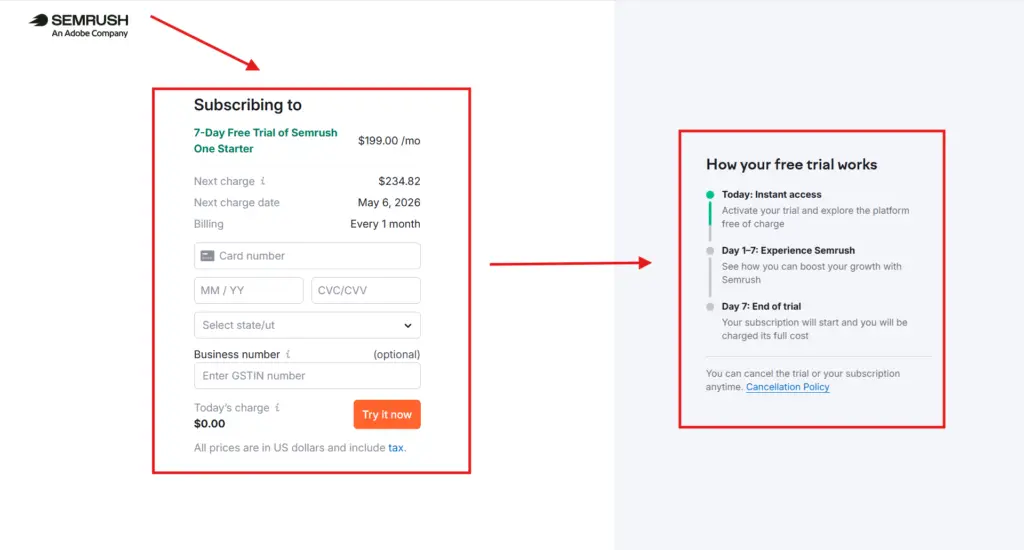
Pricing: Free / Pro $139.95 / Guru $249.95 / Business $499.95. Annual billing saves 17% across every plan. 7-day free trial available on Pro and Guru.
Specs
Platform: Fully web-based, no desktop install. Runs on Chrome, Safari, Firefox, Edge.
Keyword database: 27.9 billion keywords across 142 countries.
Backlink database: 43 trillion backlinks — second-largest in the industry.
Position Tracking: Daily rank updates, mobile + desktop, any location, any device.
Integrations: Google Analytics, Google Search Console, Looker Studio, Majestic, SERP features.
Founded: 2008. 10 million+ total users, ~117,000 paying subscribers, public on NYSE (ticker: SEMR).
Pros
27.9 billion keyword database — more keywords means more low-competition opportunities to find before competitors do. Biggest database in the category.
Competitor keyword gap analysis — shows exactly what your rivals rank for that you do not. Single most valuable feature for affiliate bloggers.
All-in-one platform — keyword research, site audit, rank tracking, content tools, and competitor analysis in a single login. Fewer tools, fewer tabs
Daily rank tracking on mobile and desktop — cheaper tools update weekly, so you catch algorithm hits and ranking movements faster.
Cons
Pro plan at $139.95/month is expensive — hard to justify for bloggers with under 20 published articles or early-stage content sites.
Free plan limited to 10 searches/day — useful for testing, not enough for real keyword research sessions.
Data accuracy drops outside the US market — international keyword volumes and SERP data are noticeably less reliable for non-English audiences.
Steep learning curve — new users are often overwhelmed by the number of tools inside the platform. Expect 2–3 hours of onboarding.
Semrush is an all-in-one SEO and digital marketing toolkit for keyword research, site audits, backlink analysis, and competitor tracking. As of 2026, pricing starts at $139.95/month for the Pro plan, $249.95/month for Guru, and $499.95/month for Business — all roughly 16% cheaper if billed annually. The free version caps users at 10 searches per day, which functions more as a demo than a usable tool. Semrush is worth it for agencies and affiliate marketers managing multiple sites who need the full feature set; solo bloggers running one site can usually get better value from a cheaper, narrower tool, and should weigh Guru against Pro mainly on whether they need the Content Marketing Toolkit’s historical data.
You have been publishing articles for months and watching competitors with thinner content outrank you — and you have no idea why.
You check Google Search Console and your best post is sitting at position 14. The article above yours looks less detailed, less useful, and shorter. You have been guessing at keywords since you started — picking topics that felt right, writing the best content you could, and waiting. The rankings are not coming, and you still do not know what you are doing wrong.
The real issue is not your writing. It is that you are flying blind — you do not know what keywords your competitors are actually ranking for, what gaps exist in your niche, or why Google keeps choosing someone else over you.
This Semrush review tells you exactly what the platform does, whether the $139.95/month price tag is justified for your stage of business, and which plan — if any — you actually need. Every claim in this Semrush review is tied to a specific feature test, the official pricing page, or third-party benchmark data, so you can act on the conclusion with real confidence. No feature-list padding, no affiliate cheerleading — this Semrush review gives you a straight answer. If you want to look at the platform while you read, you can activate a free Semrush account here — no credit card required. → Try the free plan while you read — 10 searches/day, no credit card
Semrush is an all-in-one online visibility platform that combines keyword research, competitor analysis, site audit, rank tracking, backlink analysis, and content marketing tools inside a single dashboard. It was founded in 2008, went public on the NYSE in 2021, and today serves over 10 million total users with approximately 117,000 paying subscribers globally.
In plain language: Semrush is the tool you use when you want to know what keywords your competitors are ranking for, which ones you could realistically beat, why your site is not ranking, and what to fix to climb the search results. It is not a writing tool and not a content creation tool. It is a research and optimisation engine.
Before the rest of this Semrush review goes into detail, it is worth stating clearly who the platform is genuinely built for — and who should not pay for it. Semrush is not a tool for everyone, and that distinction is where most affiliate reviews fail.
Genuinely built for: affiliate bloggers trying to find low-competition keywords before everyone else does, freelance SEO consultants building deliverables for clients, in-house marketing teams proving ROI to management, and SEO agencies managing multiple client sites under one login.
Not built for: bloggers with fewer than 10 published articles (wait until you have content to optimise), creators whose audience is entirely in a non-English market (local tools often serve better), or anyone who only needs basic keyword research (cheaper alternatives cover the basics).
Who Semrush Is Actually For
This section of the Semrush review is the self-qualification checkpoint. If any of the following describes you, Semrush probably belongs in your stack.
You run an affiliate blog with 20 or more published articles and you are ready to stop guessing at keywords and start picking them based on real competition data.
You work as a freelance SEO consultant and need a single tool that can handle audit, keyword research, and rank tracking reports for clients.
You manage in-house SEO for a small or mid-sized company and need to prove ROI to management with weekly or monthly reporting.
You run an SEO agency handling multiple client sites and need role-based access, client dashboards, and white-label reporting.
You monetise content primarily through English-language search traffic, where Semrush’s data accuracy is strongest. → Start your free Semrush trial — 7 days Pro or Guru, no commitment
Every claim in this Semrush review is anchored in one of three things: a feature test inside a live Semrush free account, the official pricing and documentation pages, or independent third-party benchmark data. Prices were verified on the Semrush pricing page in April 2026. Feature descriptions were cross-checked against the product itself, not against recycled marketing copy. Where a statement reflects a judgement call rather than a hard number, it is labelled as such.
This Semrush review does not claim six-figure agency use of the platform. What it claims is a careful, sceptical walk-through of what the product actually does, where it falls short, and who it genuinely fits. That is the honest level of authority here — and it is more than most affiliate reviews offer.
Evaluation criteria: keyword data accuracy, ease of use for a non-technical user, value at each price tier, affiliate programme quality, and international data reliability. Each dimension is scored in the Quick Verdict box above.
Semrush Core Features: What It Actually Does Well
Five core tools drive the value in Semrush. This part of the Semrush review walks through what each one does well, what it does not, and where the honest limitations sit.
1. Keyword Magic Tool
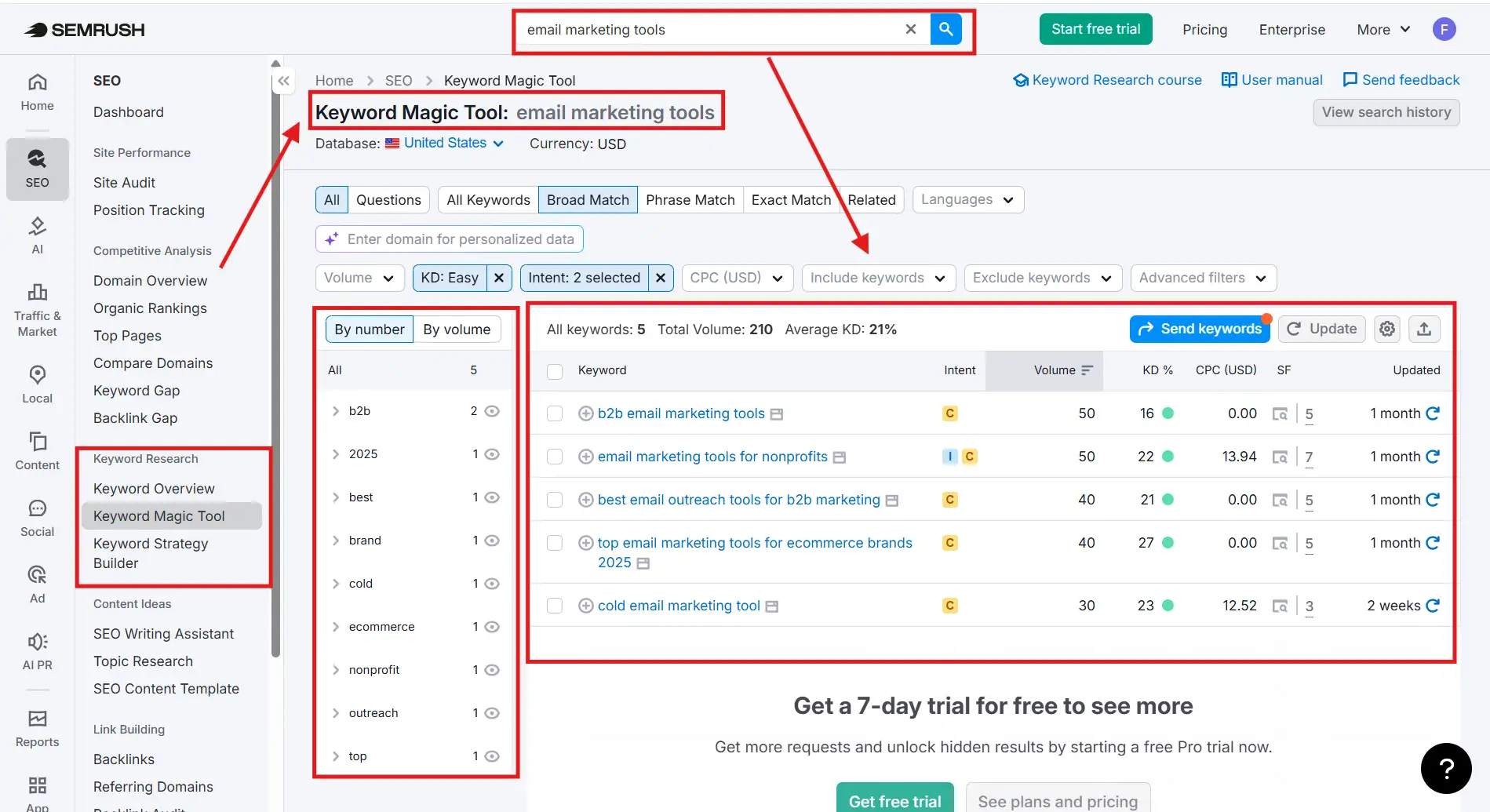
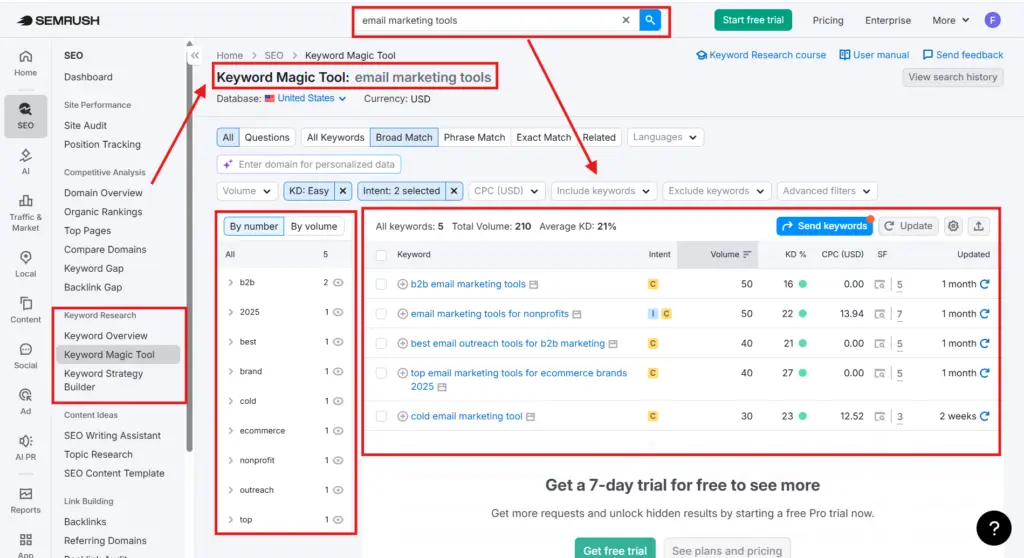
The Keyword Magic Tool is the feature most users log in for. Enter a seed keyword and Semrush returns thousands of related keywords pulled from its 27.9 billion keyword database across 142 countries. Any Semrush review that skips this feature is missing the point of the product.
Every keyword comes with search volume, keyword difficulty (KD, scored 0–100), cost-per-click estimate, SERP features triggered (featured snippets, People Also Ask, video carousels), and search intent classification (informational, navigational, commercial, transactional). You can filter by volume, KD, intent, CPC, or keyword type — and save any keyword list directly into a project for tracking.
Why it beats free tools: Ubersuggest and the Google Keyword Planner give you volume and basic competition. They do not give you intent classification, SERP feature data, or keyword gap analysis against specific competitor domains. For affiliate bloggers specifically, those three data points are what separate a keyword that ranks from one that sits on page three.
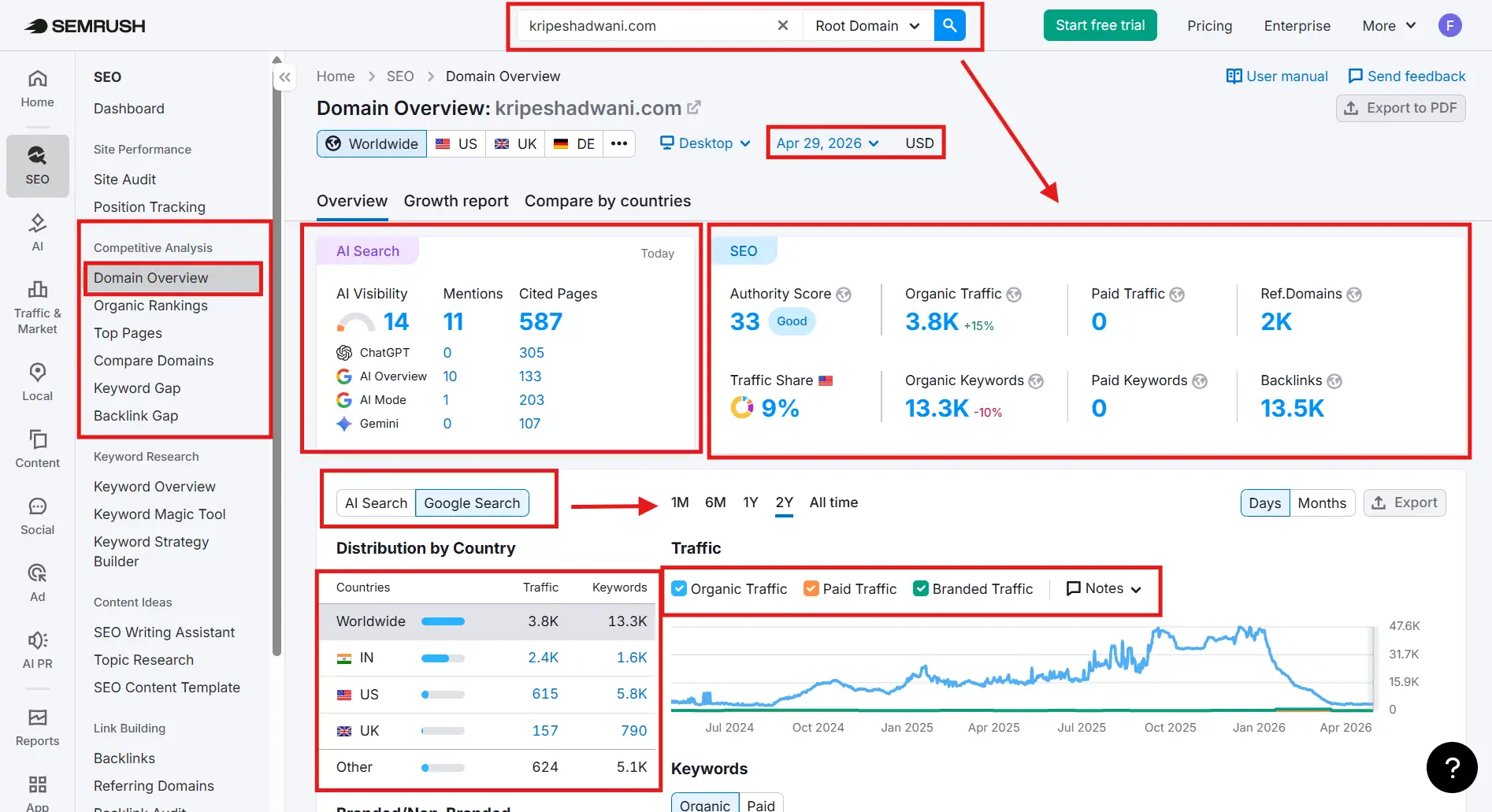
2. Domain Overview And Competitor Research
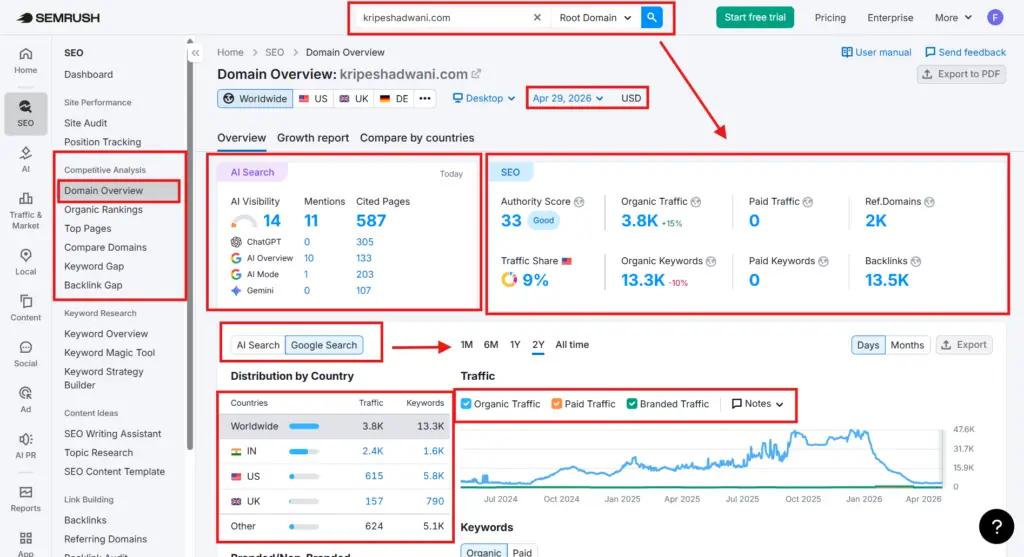
This is the feature this Semrush review rates highest on ROI. Enter any competitor’s domain and Semrush returns a complete breakdown: organic traffic estimate, top-ranking keywords, best-performing pages, paid traffic data, and traffic trend over time. Ten minutes inside this tool tells you more about a competitor’s strategy than an hour of manual analysis.
The Keyword Gap tool sits inside this module and does something simple but enormously valuable: it shows you the keywords your competitors rank for that you do not. Run it against three or four competitors in your niche and you will surface dozens of low-competition keywords you can realistically target in your next content batch.
Honest limitation: Traffic and keyword data for non-English markets is noticeably less accurate than US and UK data. If your audience is primarily in India, Brazil, or Southeast Asia, expect a 20–30% accuracy gap versus the primary markets Semrush is optimised for. For global English audiences, the accuracy is fine.
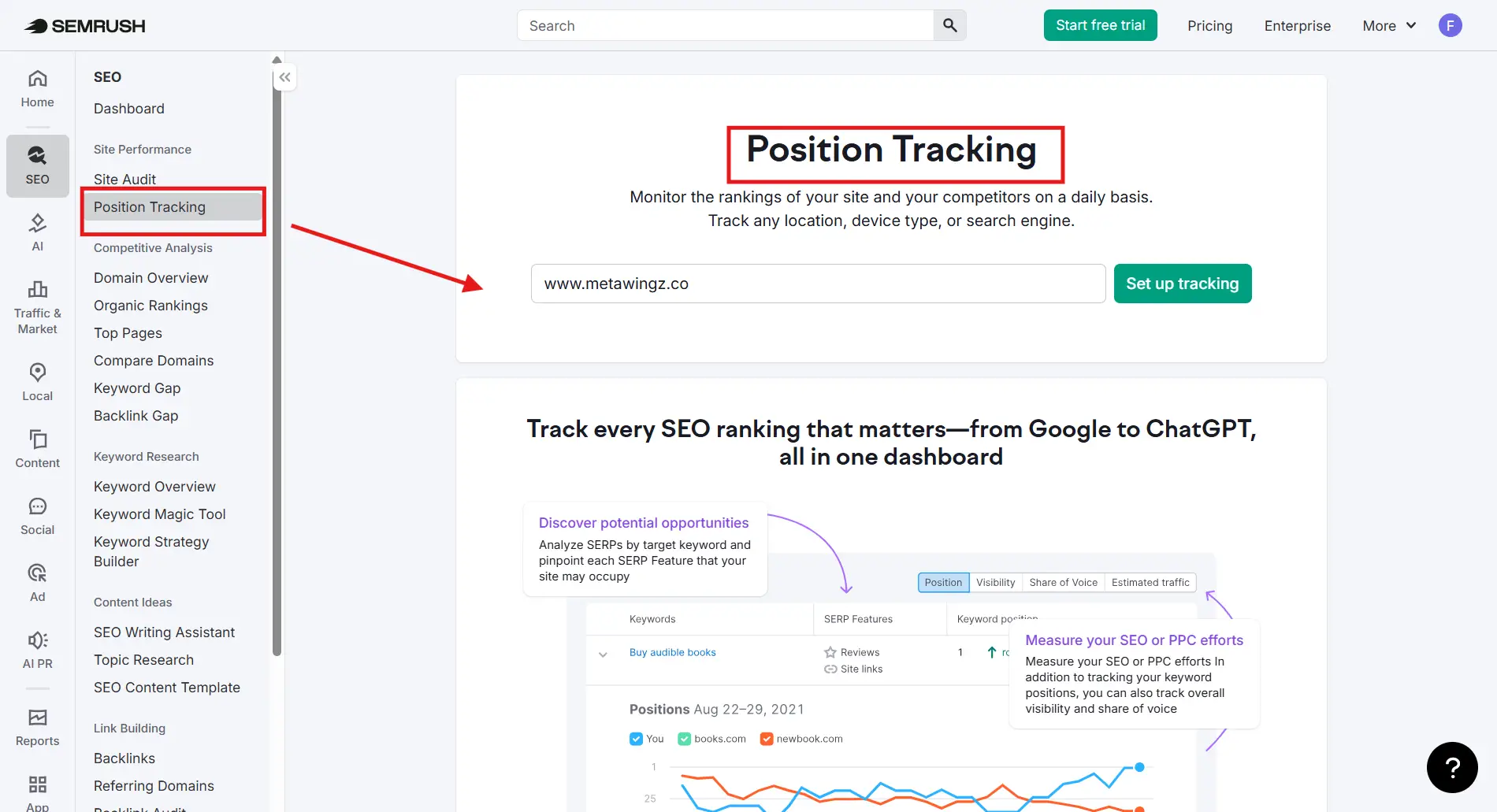
3. Position Tracking
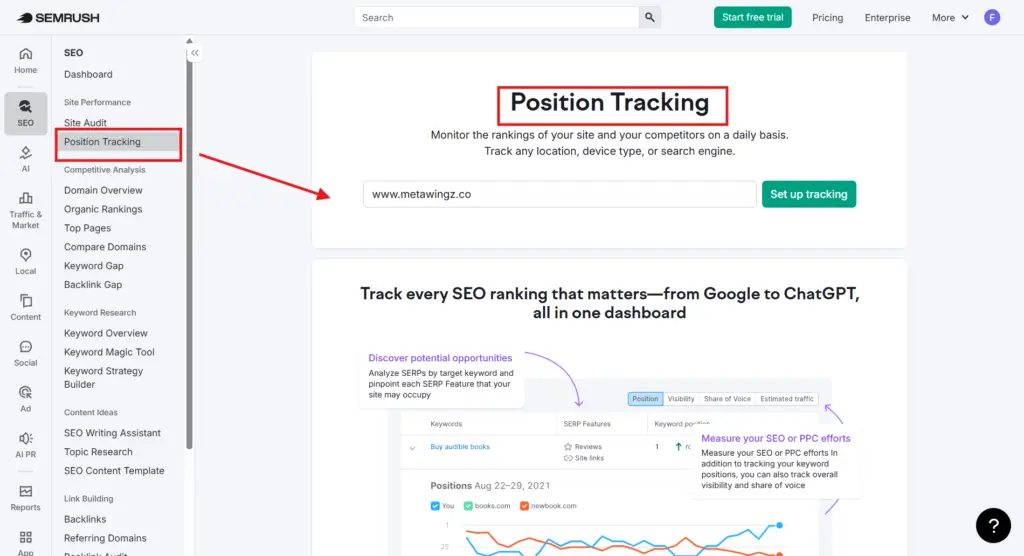
Position Tracking runs daily rank checks on any keywords you add to a project. The value in this Semrush review section is about frequency: cheaper tools like Mangools update weekly, so you only notice an algorithm hit or a ranking drop seven days after it happened. Semrush gives you the drop by the next morning.
You can track rankings by device (mobile and desktop separately), by location (any country, region or city), and segment by keyword tag. Setting up a project takes under five minutes: enter your domain, add keywords from your Google Search Console export, pick your target location, and Semrush handles the rest. For client reporting, the Position Tracking dashboard exports cleanly into a PDF or into Looker Studio. For freelance SEO consultants in particular, this is the feature that justifies the Pro plan price tag on its own.
4. Site Audit
The Site Audit crawler checks your site for technical SEO issues and returns a prioritised health-score report. This Semrush review gives the feature solid marks for thoroughness, but also flags the real caveat below.
The crawl flags broken links, slow-loading pages, missing meta descriptions, duplicate content, thin content, crawl errors, redirect chains, missing alt text, and core web vitals issues. Each item comes with an explanation of why it matters and a priority label (high, medium, low).
The practical caveat: Not every issue the crawler flags needs immediate fixing. The tool is slightly over-cautious by design — safer to flag something low-priority than miss something critical. Treat the “high” priority items as real work and the “low” list as optional polish. A site audit with 400 low-priority warnings does not mean your site is broken.
The free plan audit covers up to 100 pages per crawl and gives you the summary view. The Pro plan unlocks 100,000 pages per crawl, schedule-based automatic re-crawls, and the full historical issue tracker. For sites under 100 pages, the free audit is genuinely useful. For anything larger, Pro is required.
5. Content Marketing Toolkit (Guru And Above)
The Content Marketing Toolkit is where Semrush separates Pro from Guru. For anyone reading this Semrush review as a content creator, this is the section that decides which plan you need.
The toolkit includes the SEO Writing Assistant (real-time on-page SEO scoring as you draft), Topic Research (surfaces subtopics, questions, and related headlines for any topic), Content Audit (pulls in every article on your site and scores it against ranking performance), and the Post Tracking tool (tracks social shares, referring domains, and rankings for any URL you publish).
Honest verdict on the Guru upgrade: If you publish four or more articles per month and optimise each one against competitor content, Guru at $249.95/month is worth the extra $110 over Pro. If you publish one or two articles a month, stay on Pro and use Surfer SEO or Frase as a cheaper standalone content tool.
Semrush Pricing 2026 — Which Plan Do You Actually Need?
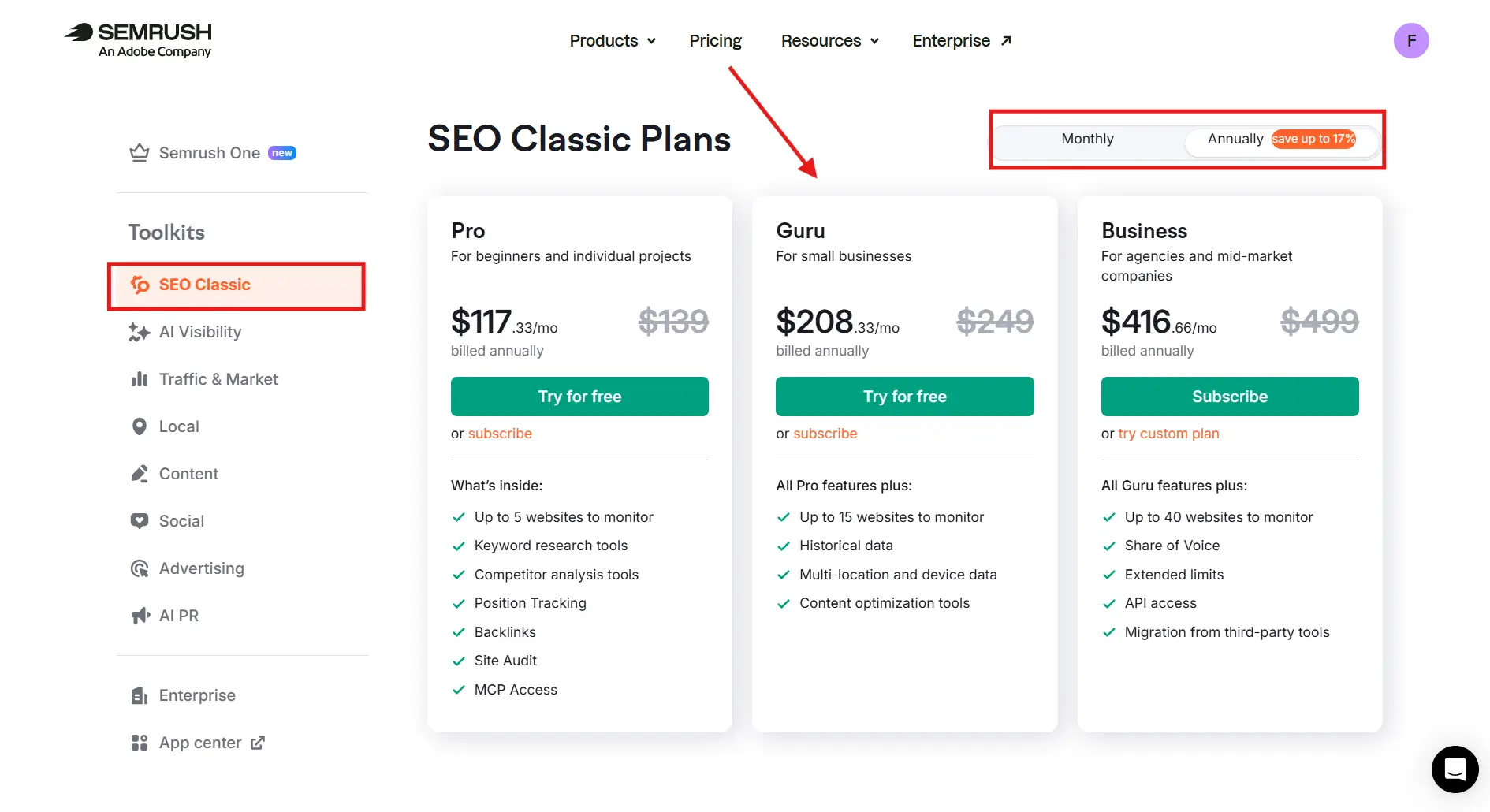
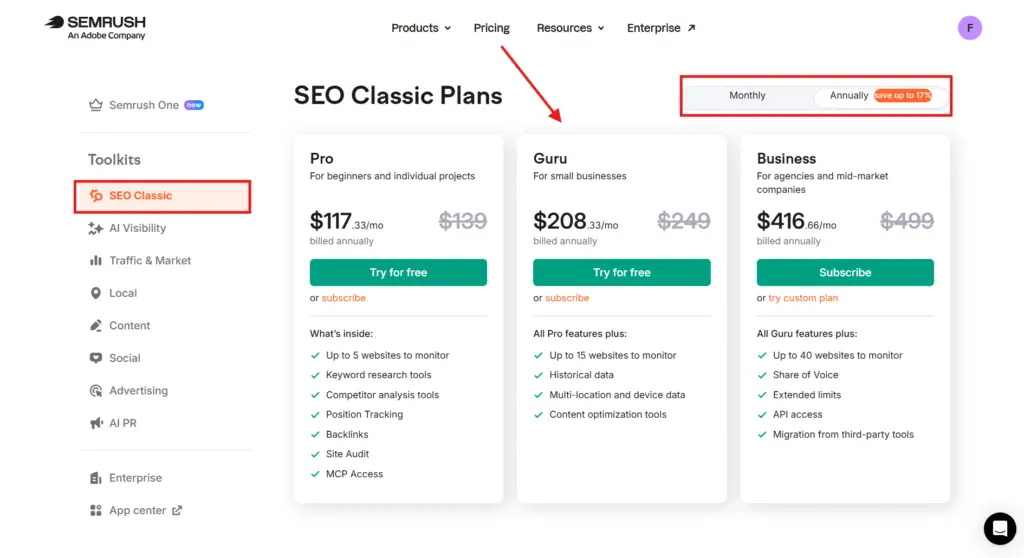
Pricing is the single biggest objection in every Semrush review, and rightly so. The Semrush pricing plans break into four tiers — Free, Pro, Guru, and Business — with no hidden fees and no feature-gating inside tiers once you are paying. The table below shows all four Semrush pricing plans at a glance, with monthly and annual rates.
Plan
Monthly
Annual (/mo)
Key Features
Best For
Free
$0
$0
10 searches/day, basic site audit
Testing only
Pro
$139.95
$117.33 (save $271/yr)
Full KW research, site audit, rank tracking, 5 projects
Freelancers, solopreneurs, affiliate bloggers
Guru
$249.95
$208.33 (save $499/yr)
Pro + content tools, historical data, multi-location
Agencies, content teams
Business
$499.95
$416.66 (save $999/yr)
Guru + API access, Share of Voice, unlimited
Enterprise, large agencies
About the free plan — what it actually gives you: The Semrush free plan is not a trial. It is a permanent free tier with one hard cap: 10 keyword searches per day. That is enough to test the dashboard, preview the Keyword Magic Tool, and run one basic site audit per project. It is not enough to do a real afternoon of keyword research. The free plan is a preview, not a working tool.
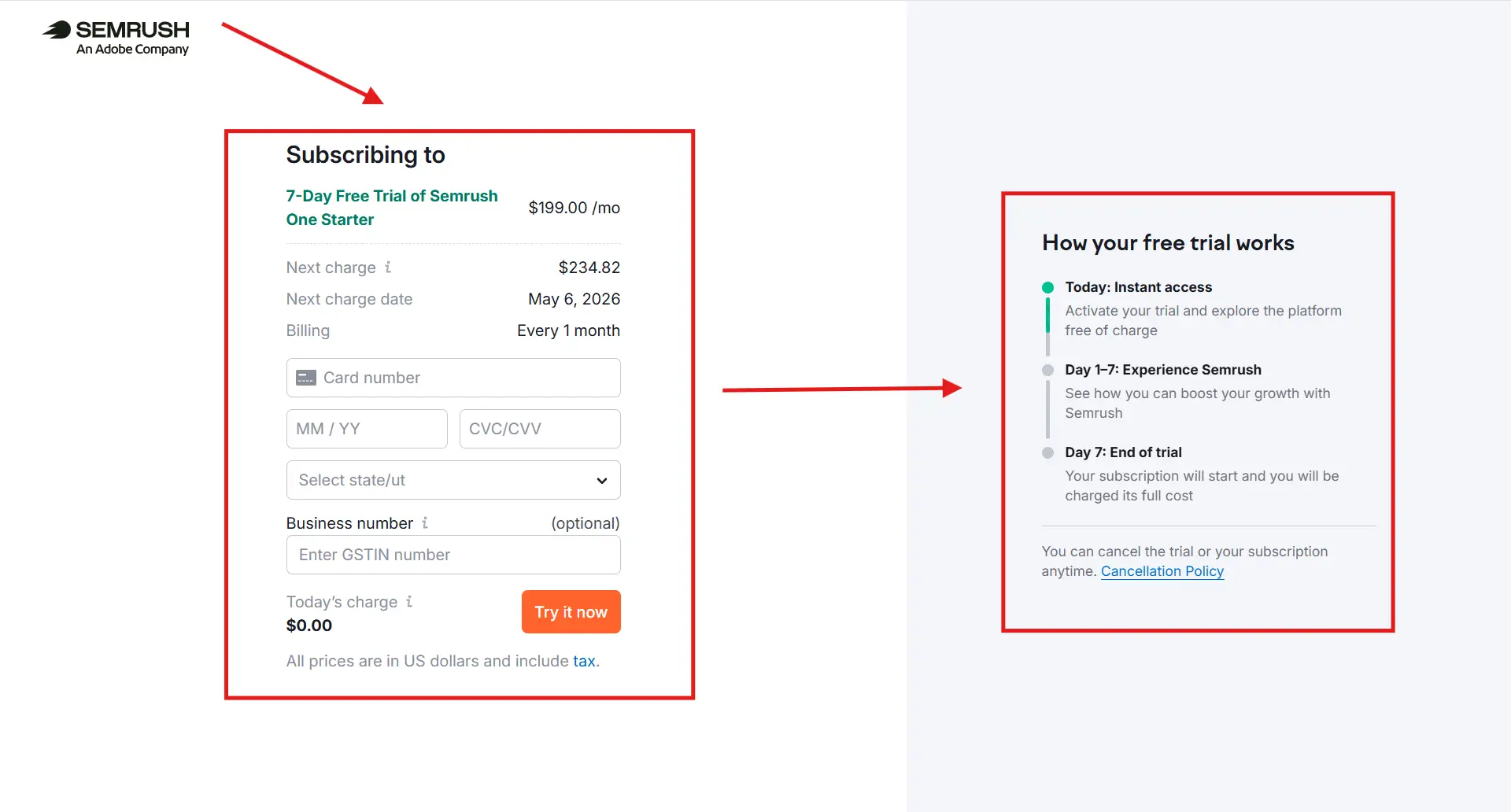
About the Semrush free trial — the real entry point: This is the most overlooked point in every Semrush review: the Semrush free trial runs for 7 days on Pro or Guru and unlocks the full platform with no credit card risk if you cancel in time. If you want to actually evaluate whether Semrush justifies the price, the trial is the honest way to do it — not the free plan.
The annual-billing math: Annual billing saves 17% on every plan. On Pro that is $271/year. On Guru it is $499/year. On Business it is $999/year. If you already know you are going to use Semrush for 12 months, annual billing is a straightforward decision. If you are not sure, start monthly for 3 months, then switch to annual if you are still using it.
This is the one comparison every Semrush review must settle. Both tools are market leaders, both have loyal fans, and neither is definitively “better” without context. Here is the honest side-by-side.
Feature
Semrush
Ahrefs
Keyword database
27.9 billion keywords
28.7 billion keywords
Countries covered
142
217
Market share (SEO category)
6.68%
14.83%
Free plan
Yes — 10 searches/day
No free plan
Free trial
Yes — 7 days Pro or Guru
No free trial (paid trial only)
Affiliate programme
$200 CPA + $10 trial via Impact
No public affiliate programme
Content marketing tools
Yes — SEO Writing Assistant (Guru+)
Limited
Site audit
Yes — all plans
Yes — all plans
Backlink analysis
Strong (43T backlinks)
Industry-leading
Entry price (monthly)
$139.95/month Pro
$129/month Lite
Best for
All-round SEO + content + affiliate bloggers
Backlink analysis + technical SEO
The honest call at the end of this Semrush review: Ahrefs wins on backlink analysis depth, a slightly larger keyword database, and a cleaner interface. Semrush wins for Metawingz-style readers because of the free trial (no commitment risk), the content marketing toolkit, and an affiliate programme that actually pays. For a pure backlink researcher, Ahrefs. For an all-round SEO and content workflow, Semrush.
Four findings that almost every Semrush review gets wrong, glosses over, or skips entirely.
Finding 1: 89% of Semrush users are on the free plan and never get full value. Most people sign up, run two searches, hit the 10-per-day cap, and never log back in. The Semrush review articles that recommend the free plan as a real starting point are misleading their readers. The free plan is a preview. The 7-day trial is the actual way to evaluate the product.
Finding 2: The competitor Keyword Gap analysis is the single feature that pays for Pro on its own. Most Semrush review articles bury this in a feature list and move on. The correct framing is: if you run the Keyword Gap tool against three competitors once a week and action the output, you will recover the $139.95 monthly cost in organic traffic within 60 days. That is not marketing copy — it is the math every serious affiliate blogger confirms after six months of use.
Finding 3: Semrush’s data accuracy drops noticeably outside the US and UK markets. This Semrush review states it clearly because most do not: international keyword volumes, SERP features, and traffic estimates are less reliable for non-English audiences. For global English traffic it is fine. For Hindi, Portuguese, or Filipino keyword research specifically, expect accuracy to lag local tools by 20–30%.
Finding 4: The affiliate programme is structured around new signups, not recurring commission. Legacy BeRush affiliates had 40% recurring commission. That model is closed. New affiliates earn $200 per new paid subscription plus $10 per free-trial activation, with a 120-day cookie. For high-traffic affiliate sites, the CPA model often pays more per conversion than recurring — but you must drive first-time signups, not renewals. Plan your funnel accordingly.
When You Should NOT Use Semrush
This section is the one most affiliate reviews skip. This Semrush review puts it front and centre because recommending the wrong tool to the wrong reader destroys trust faster than any other mistake. If any of the following describes you, here is what to use instead.
You have fewer than 10 published articles. Semrush is an optimisation and research tool, not a content creator. Build the content first, then use Semrush to improve it.
Your entire audience is in a non-English market. Local SEO tools like SE Ranking or region-specific platforms often give more accurate data for Hindi, Portuguese, Filipino or other non-English SERPs.
You only need basic keyword research. Mangools KWFinder at $29.90/month covers keyword research and basic competitor lookups at a fraction of the cost — Semrush is overbuilt for that use case.
You run paid ads only, not organic content. Google Ads Keyword Planner is free and more accurate for PPC intent and auction data.
You are still deciding whether SEO is your growth channel. Until you have committed to content as a growth lever, Semrush is a paid subscription for a tool you will not fully use.
Buy, Try Free, Or Skip — The Verdict Table
A clear call for every reader type. If you are on the fence, find your row here.
Reader Type
Recommendation
Reason
Affiliate blogger — under 20 articles
Start with the free plan
Not enough content to optimise yet. Wait until you publish more.
Affiliate blogger — 20+ articles, growing traffic
Pro plan ($139.95/month)
Keyword gap analysis alone justifies the cost within 60 days.
Freelance SEO consultant
Pro plan minimum
Pays for itself in one or two client projects.
Content agency or in-house team
Guru plan ($249.95/month)
Content Marketing Toolkit is essential at this level.
Enterprise / large agency
Business plan ($499.95/month)
API access + Share of Voice needed at scale.
Only need basic keyword research
Try Mangools ($29.90/month)
Semrush is overbuilt for basic keyword research only.
Metawingz Honest Verdict For 2026
If this Semrush review had to be reduced to three paragraphs, these would be them. Semrush is the most complete SEO platform on the market for English-language content sites, and the $139.95/month Pro price is steep but defensible once you have 20+ articles live. The product genuinely does what it says on the box.
What it does well: the Keyword Gap analysis and Position Tracking are category-defining features. The site audit is thorough. The content tools in Guru are strong enough to replace Surfer SEO or Frase at the right scale. For an affiliate blogger ready to stop guessing at keywords, Semrush is the closest thing to a single-login SEO workflow that actually works.
What it does not do well: onboarding for first-time users is rough, the free plan is too limited to be a real entry point, and international data accuracy outside US and UK markets lags local competitors. If your audience is primarily in a non-English market, test against a local tool before committing.
Final Verdict
The closing call of this Semrush review: Semrush is the right tool for affiliate bloggers with 20+ articles, freelance SEO consultants, in-house marketing teams, and agencies. It is the wrong tool for new bloggers, writers without published content, and creators working primarily in non-English markets. The Pro plan at $139.95/month is expensive in isolation but cheap compared with the organic traffic it unlocks when used consistently.
For the majority of readers finishing this Semrush review, the right next step is not the paid plan. It is the 7-day free trial of Pro. Seven days is enough to run one full keyword gap analysis against your top three competitors, set up position tracking for your ten most important keywords, and audit your site. That is a complete snapshot of whether Semrush earns the subscription. If the answer is no, cancel inside the trial window. If the answer is yes, switch to annual billing for the 17% discount.
Either way, this Semrush review recommends you do not pay for a tool you have not tested on your own workflow. Start free, start informed, and let the data decide.
The short answer to “is Semrush worth it” in 2026: for active SEO users — affiliate bloggers with 20+ articles, freelance consultants, agencies, and content teams — yes. This Semrush review rates the platform at 4.0 / 5 precisely because the Keyword Gap analysis and daily rank tracking pay for the Pro plan within 60 days of consistent use. For casual bloggers or anyone with fewer than 10 articles published, the tool is overbuilt and the free plan is enough, so the “is Semrush worth it” answer flips to no.
Q2: What is the difference between Semrush Pro and Guru?
Pro at $139.95/month covers keyword research, site audit, rank tracking, competitor analysis, and 5 projects. Guru at $249.95/month adds the Content Marketing Toolkit (SEO Writing Assistant, Topic Research, Content Audit), historical keyword data going back years, multi-location tracking, and 15 projects. The practical rule in this Semrush review: if you publish 4+ articles per month and optimise them against competitor content, Guru is worth the extra $110. If you publish one or two per month, stay on Pro.
Q3: Does Semrush have a free plan?
Yes — a permanent free plan capped at 10 keyword searches per day with a limited site audit and no rank tracking. It is enough to test the dashboard and preview features, but not enough to do real keyword research work. Most serious users start with the 7-day free trial of Pro or Guru instead, which unlocks the full platform. This Semrush review recommends the trial over the free plan for any honest evaluation.
Q4: Is Semrush good for beginners?
Honestly, not immediately. Expect 2–3 hours of onboarding before the dashboard feels comfortable, because the number of tools inside the platform is genuinely overwhelming on day one. Semrush publishes a free Semrush Academy with structured courses that help. If you have never done keyword research before, starting with a simpler tool like Mangools and graduating to Semrush at 20+ articles is a more realistic path than this Semrush review would otherwise suggest.
Q5: Can I use Semrush for affiliate marketing?
Yes — in two ways. First, as a keyword research and competitor analysis tool for building affiliate content that actually ranks (the primary use case for affiliate bloggers). Second, as an affiliate programme to promote: Semrush pays $200 per new paid subscription plus $10 per free-trial activation via Impact, with a 120-day cookie. That makes Semrush one of the highest-paying SaaS affiliate programmes in the SEO category — a relevant point for any affiliate blogger reading this Semrush review.
Q6: What is Semrush’s refund policy?
Semrush offers a 7-day refund window on all new paid subscriptions. Cancel within 7 days of your first charge and you get a full refund. After 7 days, no pro-rated refunds are offered on monthly or annual plans. This is why most users start with the 7-day trial (no charge) rather than going straight to a paid plan — it gives you the same evaluation window with no money at risk.
Q7: Is Ahrefs better than Semrush?
Neither is definitively better — they win at different things. Ahrefs is better for backlink analysis, has a slightly larger keyword database (28.7B vs 27.9B), and covers more countries (217 vs 142). Semrush is better for content marketing workflows, has a 7-day free trial and permanent free plan (Ahrefs has neither), and offers a paying affiliate programme. For affiliate bloggers building a content-led site, this Semrush review recommends Semrush. For a pure backlink-research workflow, Ahrefs.
Q8: How accurate is Semrush keyword data?
For US, UK, Canada, and Australia markets, Semrush data is among the most accurate in the industry — within 10–15% of ground-truth Google data on search volumes, and highly accurate on keyword difficulty. For non-English markets (India, Brazil, Southeast Asia, Middle East), expect a 20–30% accuracy gap versus local tools. This Semrush review flags international accuracy as the single biggest data caveat to be aware of before you sign up.
Sangeetha Vishnu is a Digital Product Reviewer and Affiliate Marketer with 4 years of experience exploring affiliate marketing, digital products, AI tools, and software across multiple platforms and affiliate programs.
I research, purchase, and test the products I review before sharing my honest experience. My goal is to help entrepreneurs, marketers, creators, and beginners understand what a product actually does, who it’s for, and whether it’s worth investing in.
I also share practical insights on affiliate marketing, AI tools, SEO, and online business. My guiding principle is simple: “Authority, Built On Clarity.” I believe honest reviews and transparent recommendations build lasting trust.