Private domain registration is a privacy service that replaces your personal contact information in the public WHOIS database with your domain registrar's proxy details. Anyone querying your domain's WHOIS record will see the registrar's data, not yours. Namecheap includes this service free for the lifetime of the domain — powered by Withheld for Privacy, a provider based in Iceland.
It prevents spam, protects your home address from public exposure, and reduces vulnerability to targeted harassment. It will not protect you from legitimate legal disclosure. Most domain owners benefit from it. On Namecheap, there is no reason not to have it enabled.
Specs
Service: Private Domain Registration — powered by Withheld for Privacy
Former name: WhoisGuard — renamed in 2021 when provider changed
Provider: Withheld for Privacy ehf — based in Reykjavik, Iceland
Price: Free for the lifetime of the domain — verified July 2026
Auto-added at checkout: Yes — enabled by default for all eligible domains
What it hides in WHOIS: Your name, postal address, phone number, and email address
Email forwarding: Yes — proxy email routes legitimate messages to your real inbox
Email auto-rotation: Yes — proxy email can rotate automatically to defeat scrapers
What it does NOT hide: Hosting IP, site content, data under valid legal disclosure
Automatically enabled by default at checkout for eligible domains
Significantly reduces spam from WHOIS data scrapers
Proxy email auto-rotation feature defeats mailing list scrapers
Provider (Withheld for Privacy, Iceland) does not store your real data
Cons
Not available for .uk, .us, .ca, .de, .fr, .au, .eu and other ccTLDs
Does not prevent disclosure under valid court order or UDRP proceeding
Does not anonymise your website, hosting IP, or DNS records
Not a substitute for legal privacy measures if full anonymity is required
Existing pre-2021 domains may need a manual dashboard check to confirm new provider is active
Your name, home address, phone number, and personal email are searchable by anyone right now — if you skipped private domain registration.
You registered a domain at some point — maybe for a business, a blog, or a project you were testing. You filled in your contact details, paid, and moved on. What the registrar’s checkout page probably didn’t explain is that your real name, home address, and phone number were simultaneously submitted to a public database — one anyone can query, for free, in seconds.
The real problem isn’t the exposure itself. It’s that most people don’t find out their WHOIS data is public until they start receiving targeted spam — or until someone uses it to find them. And many registrars charge a separate annual fee to protect the information they were already legally required to collect from you.
This guide breaks down exactly what private domain registration does, who genuinely needs it, and what Namecheap’s domain privacy actually protects — and what it doesn’t. By the end, you’ll have a direct yes or no answer for your specific situation, not a generic “it depends.”
Private domain registration replaces your personal contact details in the public WHOIS database with your registrar’s proxy information — your real name, address, and email are hidden from public view.
Every gTLD domain (.com, .net, .org) is legally required to list registrant contact data in WHOIS under ICANN policy. Private domain registration is the only way to remove your personal information from that public record.
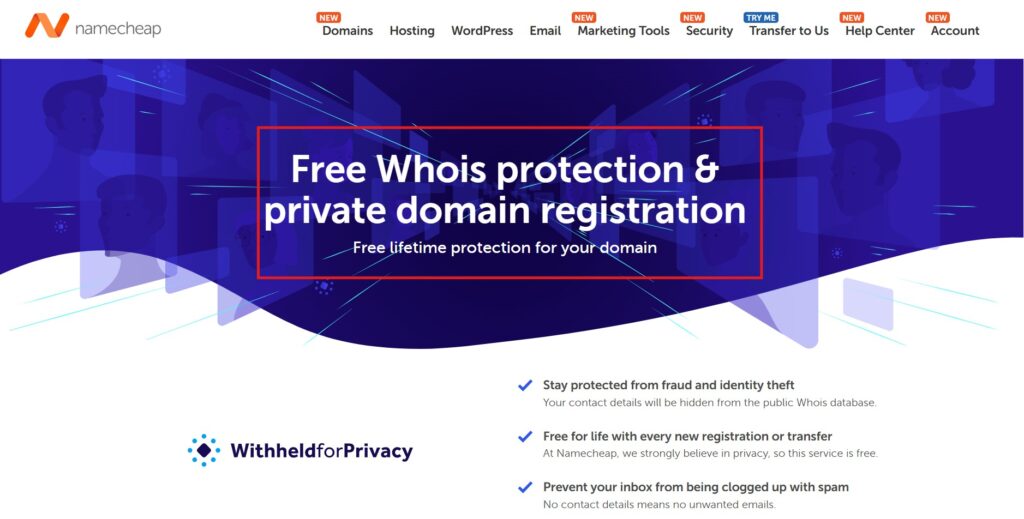
Namecheap domain privacy — powered by Withheld for Privacy (based in Iceland) — is free for the lifetime of every eligible domain. Most competitors charge $8–$15 per year for equivalent protection.
Private domain registration does not make you anonymous under legal process. ICANN policy requires registrars to disclose real registrant data under a valid court order or UDRP dispute proceeding.
Highest-risk group: anyone who registered using their home address — bloggers, freelancers, solo creators, and small business owners working from home.
ccTLD extensions have their own WHOIS rules. Namecheap’s privacy service cannot be used with .uk, .us, .de, .ca, .fr, .au, and several others — check your specific extension before relying on privacy.
Namecheap’s proxy email address can be configured to automatically rotate at regular intervals — a security feature that invalidates scraped email addresses before spammers can use them.
Disclaimer : I strongly believe in transparency. Some links on this website are affiliate links, which means I may earn a small commission if you purchase through them — at no extra cost to you. This helps support the work I do and allows me to continue creating honest reviews, tutorials, and creator-focused content.
What Is Private Domain Registration?
Private domain registration replaces your personal contact information in your domain’s public WHOIS record with your registrar’s proxy details. Instead of listing your name, home address, phone number, and email, the WHOIS database shows the registrar’s proxy contact data. Anyone querying your domain sees the proxy information — not your personal details.
When you register a domain name, ICANN — the international body governing domain naming — requires registrars to collect your real contact information and submit it to the public WHOIS database. This has been standard practice since the early days of the internet, originally designed to help network administrators identify who owns a domain and resolve technical or legal disputes.
The WHOIS database is fully public. It can be queried by anyone through a registrar’s WHOIS lookup tool, third-party sites like who.is or whois.domaintools.com, or directly via command-line tools. No login is required. No payment is required. Your data is simply there, readable by anyone who knows your domain name. — Source: ICANN WHOIS Policy.
Private domain registration — also called domain privacy protection, WHOIS privacy, or anonymous domain registration — works by inserting a proxy layer between your personal data and the public record. The registrar submits their service provider’s contact details on your behalf, leaving your personal information off the public-facing record. — Source: Withheld for Privacy, withheldforprivacy.com, 2026.
Important: Private domain registration doesn’t make you untraceable. It makes you un-searchable by standard public means. Your real contact information is still stored with the registrar for legal compliance. What changes is what the public WHOIS record actually shows to the world.
What Does Your Public WHOIS Record Actually Show Right Now?
A public WHOIS record contains the registrant’s full name, postal address, phone number, and email, plus the domain’s creation date, expiry date, and nameserver details. Without privacy protection, every one of these details is visible to anyone who searches your domain in any WHOIS tool — no account or login required.
If you registered your domain without private domain registration, the public WHOIS record currently lists all of the following.
Your full legal name — exactly as entered at registration
Your home or business postal address
Your personal or business phone number
Your personal or business email address
The domain’s original registration date
The domain’s expiry date — publicly visible to domain renewal spammers
Your domain’s nameserver information
This information is aggregated by data brokers, scraped by spam list compilers, and indexed by marketing intelligence tools. Within days of registering a domain, many owners start receiving unsolicited email to the exact address used at registration — not because they signed up for anything, but because their email is now listed in a public database that anyone can download and search.
Targeted domain renewal scams are a documented risk. Once your domain’s expiry date and registrant email are public, spammers send official-looking renewal notices from fake registrars — hoping you’ll pay them instead of your actual provider. This works because the expiry date and your email are completely open. — Source: Namecheap, What Is Domain Privacy, 2026.
When Namecheap’s private domain registration is active, all personal fields are replaced by Withheld for Privacy’s proxy data. The public WHOIS record shows: “Withheld for Privacy Purposes” as the name, their Reykjavik, Iceland address, a proxy phone number, and a unique anonymised forwarding email in the format [hash].protect@withheldforprivacy.com. Real emails sent to that address are filtered for spam and forwarded to your actual inbox.
What Nobody Tells You: Your WHOIS Data Gets Scraped Within Hours
Most guides warn you about WHOIS exposure. None of them tell you the timeline. ICANN publishes zone files — daily updated lists of every newly registered domain in the world. Data harvesting bots monitor these files continuously. Within hours of your domain going live, scrapers have already queried your WHOIS record, pulled your name, address, and email, and added them to bulk marketing lists.
By the time you receive your first spam email, your personal details have already been sold to multiple lists. Enabling private domain registration after the fact stops future exposure — but it cannot undo the initial scrape window.
The window that matters: the first 24 hours. Enable private domain registration at the moment of purchase — not after. Namecheap does this automatically by default at checkout. If you transferred a domain from another registrar without privacy enabled, activate it now. — Source: ICANN Zone File Access Program, icann.org/en/zone-file-agreements, 2026.
Private domain registration is worth it for most domain owners — especially anyone who registered using a personal address or email. It prevents your contact details from being publicly searchable. On Namecheap, it costs nothing, which removes the main reason people skip it. It’s less relevant only for businesses that already publicly list their address in company registries.
So do I need domain privacy, in plain terms? The short answer: yes — for most people, and especially for anyone who registered a domain using their home address or a personal email address.
You should enable private domain registration if:
You used your home address when registering the domain
You used a personal email address at registration
You’re a blogger, freelancer, or solo creator working from home
You’ve received spam to the exact email address you used at registration
You want to prevent your physical location from being publicly searchable
You’re a journalist, researcher, or content creator who values online anonymity
You register domains for clients and want to protect your own details as the technical contact
You can reasonably skip private domain registration only if:
You represent a registered business that already lists its address publicly in company registries — the same data is findable regardless
You’re registering under a ccTLD that doesn’t permit privacy protection (.uk, .us, .ca, .de, .fr, .au and others)
Your specific regulatory environment requires your real WHOIS data to remain publicly visible
The Namecheap cost argument is simple: private domain registration is free. There’s no recurring annual fee. Every standard objection — that it adds cost, that it’s not worth the renewal — disappears completely. On Namecheap, the question isn’t whether private domain registration is worth paying for. The question is whether there’s any reason to leave it off. For most registrations, there isn’t.
One point most reviews skip: the WHOIS database is searchable by name, not just by domain. If someone knows your full name, they can run a name-based WHOIS query and find every domain you’ve ever registered under that name — across all TLDs. Private domain registration closes that exposure vector. Without it, your entire domain portfolio is discoverable from a single name search.
What Is Namecheap Domain Privacy — and Why Is It Free When Competitors Charge?
Namecheap domain privacy replaces your personal WHOIS data with proxy details from Withheld for Privacy — an Iceland-based provider — free for the lifetime of your domain. Previously called WhoisGuard, the service changed providers in 2021 but stayed free. GoDaddy charges $9.99/year for equivalent protection. Namecheap includes it automatically with every eligible registration.
Namecheap’s private domain registration has been free since 2019, when they removed the WhoisGuard fee across all eligible domains. In 2021, Namecheap switched providers from WhoisGuard to Withheld for Privacy — an Icelandic company specifically built for ICANN-accredited registrars. The service name changed; the protection and the price (free) did not. Withheld for Privacy’s Iceland jurisdiction is meaningful: Iceland has some of the strongest data privacy standards in the world. — Source: Withheld for Privacy ehf, withheldforprivacy.com, 2026.
What private domain registration on Namecheap does, specifically:
Replaces your registrant name with a Withheld for Privacy proxy identifier
Replaces your home or business address with Withheld for Privacy’s Reykjavik, Iceland address
Replaces your phone number with their proxy contact number: +354 421-2434
Replaces your email with a unique forwarding address (@withheldforprivacy.com) that routes real correspondence to your inbox
Optional: automatically rotates the proxy email address at regular intervals — invalidating any scraped addresses before spammers can use them
What private domain registration does NOT do:
It does not protect you from legal disclosure. ICANN’s Registrar Accreditation Agreement requires Namecheap to hand over real registrant details under valid legal process — a court order, a UDRP proceeding, or legitimate law enforcement requests. If you’re using your domain for legitimate purposes, this limitation is irrelevant. If you’re not, privacy protection won’t help you.
It does not anonymise your website or hosting. Your server’s IP address is still publicly visible via DNS records. Your site’s content is public. Anyone seriously investigating domain ownership has more vectors than WHOIS. Private domain registration closes the easiest and most commonly exploited one — the public contact data listing — but it is one layer, not a complete anonymity solution.
Competitor privacy pricing
Registrar
Privacy Service Name
Annual Cost
Namecheap
Withheld for Privacy (private domain registration)
Free — lifetime of domain ✓
GoDaddy
Full Domain Privacy
$9.99/year per domain — Source: godaddy.com/domains/domain-protection, July 2026
How Do You Make Your Domain Registration Private with Namecheap?
To make your domain registration private on Namecheap, domain privacy is added automatically at checkout — confirm it’s on before completing your purchase. For an existing domain, log in, go to Domain List > Manage > Domain tab > Domain Privacy, and enable it. The service is free. Your WHOIS record updates within 24–48 hours.
For a new private domain registration — step by step:
Navigate to namecheap.com and search for your desired domain name.
Add the domain to your cart.
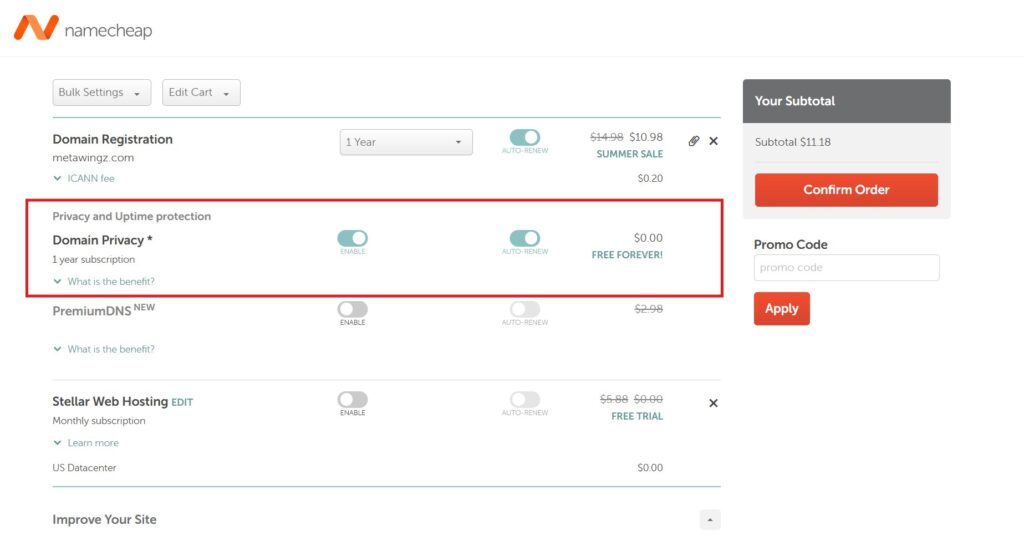
At checkout, private domain registration appears automatically in your cart summary — confirm it shows as enabled (Namecheap adds it by default for eligible domains).
Complete your domain purchase. Domain privacy activates within minutes of registration.
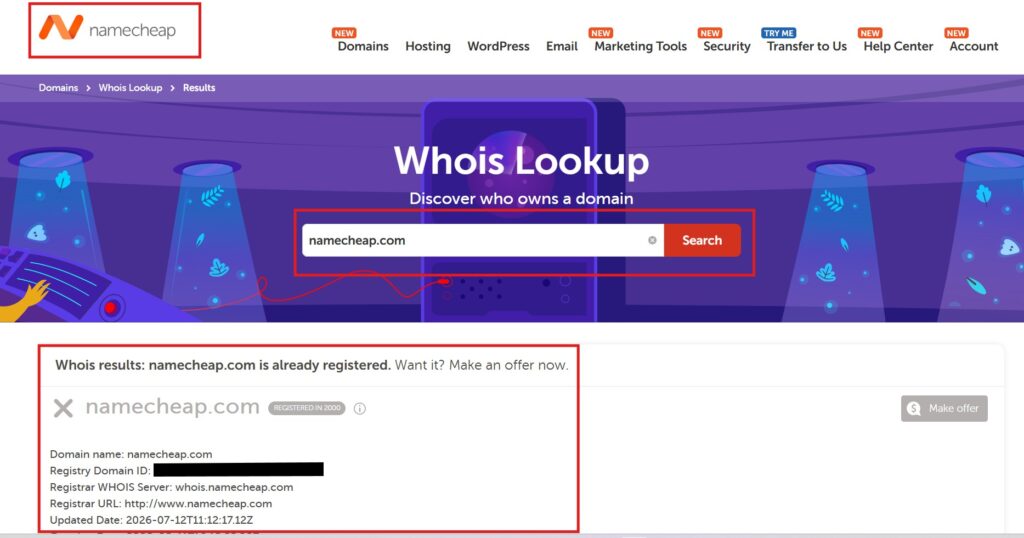
Verify: use the Namecheap WHOIS tool at namecheap.com/domains/whois/ and search your domain. The registrant fields should show “Withheld for Privacy Purposes” — not your real name.
For an existing domain already on Namecheap:
Log in to your Namecheap account at namecheap.com.
Click “Domain List” in your dashboard left menu.
Click “Manage” next to the domain you want to protect.
Under the “Domain” tab, locate the Domain Privacy section.
Click “Buy Now” — you will not be charged. This activates free private domain registration.
Save changes. The public WHOIS record updates within 24–48 hours.
How to verify private domain registration is working: After enabling, use Namecheap’s own WHOIS tool or any public WHOIS lookup and search for your domain. Registrant contact fields should now show “Withheld for Privacy Purposes” and the Withheld for Privacy proxy address in Reykjavik — not your personal name and address. If your real data still appears after 48 hours, return to your domain dashboard and confirm the setting saved correctly.
What Is the Difference Between Public and Private Domain Registration?
Public domain registration exposes your real name, address, phone number, and email in the WHOIS database. Private domain registration replaces those details with a registrar proxy. Domain ownership, DNS settings, and legal accountability remain identical in both cases. Only what the public WHOIS record displays changes — nothing about how the domain functions or who owns it.
Feature
Public Registration
Private Domain Registration
Name in WHOIS
Your real full name
Privacy proxy identifier
Address in WHOIS
Your real address
Withheld for Privacy, Reykjavik, Iceland
Phone in WHOIS
Your real number
Proxy number: +354 421-2434
Email in WHOIS
Your real email
[hash].protect@withheldforprivacy.com
Domain ownership
Unchanged
Unchanged
DNS / nameservers
Unchanged
Unchanged
Legal accountability
Same
Same
Spam exposure risk
High — data scraped freely
Significantly reduced
Cost on Namecheap
$0 (but data is public)
$0 (data is protected)
One clarification worth repeating: private domain registration does not change who legally owns the domain. If someone disputes your domain ownership through a UDRP proceeding, your registrar will disclose your real details to the arbitration panel. The domain stays registered to you — private domain registration only shields your contact data from casual public searches, not from legitimate legal and administrative processes.
Organisations with legal transparency requirements — government entities, publicly traded companies, and regulated industries with mandatory address disclosure — may not be appropriate candidates for private domain registration. Additionally, several country code extensions (.uk, .us, .ca, .de, .fr, .au and others) do not permit privacy protection at all due to registry restrictions, regardless of the registrar you choose.
Private domain registration is not appropriate for every situation, and in some cases isn’t technically permitted.
Registered businesses with mandatory transparency obligations: Some regulatory frameworks require businesses operating websites to display their registered company address. Private domain registration doesn’t change anything material here — the address is already findable through company registries.
Country code domain owners on restricted extensions: Namecheap’s private domain registration cannot be used with .uk, .us, .ca, .de, .fr, .au, .eu, .nl, .sg, .in, .co.uk, .me.uk, .org.uk, .com.au, .net.au, .org.au, .ch, .li, and several others. Always check your specific TLD.
Government agencies and public institutions: Public-sector entities often have mandatory disclosure requirements extending to WHOIS data. Check your jurisdiction’s specific rules.
Anyone with serious anonymity requirements beyond WHOIS: If your concern is comprehensive legal anonymity, private domain registration alone will not get you there. It closes one specific data exposure point; it is not a complete anonymity solution.
The honest bottom line: Private domain registration is a meaningful first layer of personal data protection. It is not a comprehensive anonymity solution. If your requirement is full legal anonymity, domain privacy alone will not get you there. Understand that scope and plan accordingly.
My Honest Take on Private Domain Registration
For most domain owners, private domain registration is a clear yes — especially on Namecheap, where it costs nothing. The main reason people skip it is cost. On Namecheap, that reason doesn’t exist. If you registered using a personal address or email, enabling domain privacy is the highest-value zero-cost privacy step available to you today.
I have private domain registration enabled on every domain in my portfolio — including Metawingz.co itself. Setting it up took one checkbox at checkout. It has required zero maintenance since enabling it. In that time, spam to the registration email address has dropped significantly compared to domains where I hadn’t yet enabled it.
Should you enable private domain registration on Namecheap? If you registered any domain using your home address or personal email, yes — immediately and at no cost. Here is what your setup looks like when it is working correctly:
Someone searches your domain name in a WHOIS tool — a journalist, a competitor, a marketer with a scraping script, or a spammer hunting fresh email addresses. Instead of your name and home address, they see “Withheld for Privacy Purposes” and an Icelandic proxy address. The trail stops there.
Your inbox stays cleaner. You don’t receive domain renewal scam emails targeting the exact address you used at registration. You don’t receive physical mail from data brokers who harvested your WHOIS data. And if you ever decide to sell your domain, a potential buyer’s first WHOIS search doesn’t immediately reveal your identity before you’ve had any conversation with them.
How do you check if private domain registration is already active on your domain? The answer takes 30 seconds: go to namecheap.com/domains/whois/, search your own domain name, and look at the Registrant Contact section. If it shows your real name and address, private domain registration is not active. If it shows “Withheld for Privacy Purposes,” you’re protected.
What to be direct about: Private domain registration is not a security measure for the domain itself. It doesn’t prevent domain hijacking, doesn’t protect your hosting account, and doesn’t secure your website’s content. It protects one specific data point — your personal contact information in one specific public database. That scope is narrow. Within that scope, it works exactly as described.
On Namecheap specifically: the free-forever approach is genuinely unusual in the domain registrar industry. Most registrars treat private domain registration as a revenue add-on. Namecheap built it into the base product and made it the default. Whether that’s driven by GDPR pressure, competitive positioning, or genuine user advocacy — the outcome for you is the same. You get meaningful personal data protection at no cost. Namecheap vs Bluehost hosting and domain comparison
Metawingz Verdict — Do You Need Private Domain Registration?
Most domain owners need private domain registration — especially anyone who registered using a personal address or email. On Namecheap, it’s free and enabled by default at checkout. There’s no meaningful downside for personal or small business domains, and no cost reason to skip it. If it’s not already active, enable it today — it takes two minutes.
Private domain registration is one of the highest-value, zero-cost actions available to any domain owner. The only remaining question is whether your specific situation — your TLD, your business type, your regulatory environment — is one of the edge cases where it doesn’t apply.
Your Profile
Verdict
Reason
Solo blogger or creator
✅ Yes
Home address and personal email exposed without private domain registration
Freelancer or consultant
✅ Yes
Prevents personal contact details from being publicly searchable
Small business owner (home-based)
✅ Yes
Eliminates home address exposure and reduces spam — free on Namecheap
Established company (public address)
⚠️ Probably yes
Private domain registration still reduces spam and contact scraping even if address is listed elsewhere
Government / regulated entity
⚠️ Check rules
May be required to display real contact data publicly
ccTLD owner (.uk, .us, .de etc.)
⚠️ Verify first
Privacy protection not permitted on many country code extensions
Private domain registration is a service that replaces your personal contact details in the WHOIS database with your registrar’s proxy information. Every domain registration must include real registrant data under ICANN policy, but private domain registration shields that data from public view. Anyone who searches your domain’s WHOIS record sees the registrar’s proxy details — not your name, address, phone number, or personal email. On Namecheap, this is included free for all eligible domains.
Q2: What is domain privacy protection?
Domain privacy protection is the same service as private domain registration — the name varies by registrar. It replaces publicly visible WHOIS contact data with a registrar proxy. On Namecheap, it’s powered by Withheld for Privacy (Iceland-based). On GoDaddy, it’s Full Domain Privacy at $9.99/year. The function is identical: your personal contact information is hidden from public WHOIS searches. Legitimate emails are still forwarded to your real inbox through the proxy system.
Q3: Is private domain registration worth it?
Private domain registration is worth it for most individuals and small businesses — especially those who registered using their home address or personal email. It prevents your real contact details from being publicly searchable in WHOIS and significantly reduces spam. On Namecheap, it’s free, which removes the main objection entirely. The only situations where private domain registration is less relevant are established businesses with publicly listed addresses, or ccTLD extensions that don’t permit privacy by registry policy.
Q4: Do I need private domain registration?
You need private domain registration if you used a personal address, home address, or personal email when registering your domain. Without it, that data is publicly visible in WHOIS and is frequently scraped by spammers and data brokers. If you’re using a business address that’s already publicly listed elsewhere, the benefit is lower — but on Namecheap, where it costs nothing and is already enabled by default, there’s no practical reason to leave it off.
Q5: Is domain privacy protection worth it?
Domain privacy protection is worth it when it costs under $10/year — and even more so when it costs nothing. Namecheap includes private domain registration free, which changes the calculation entirely. The protection is real: it prevents your personal contact data from being publicly searchable, reduces spam, and closes the easiest route for anyone trying to find your personal address from your domain name. For anyone who registered with personal contact details, the answer is a clear yes.
Q6: How to make domain registration private?
On Namecheap, private domain registration is enabled by default at checkout — confirm it’s on before completing your purchase. For an existing domain, go to Domain List > Manage > Domain tab and activate Domain Privacy at no charge. Your WHOIS record updates within 24–48 hours. For other registrars, look for “WHOIS privacy” in account settings — expect to pay $8–$15/year unless your registrar includes it free.
Q7: What is the difference between public and private domain registration?
Public domain registration makes your real name, address, phone number, and email visible in WHOIS to anyone who queries your domain. Private domain registration replaces those details with the registrar’s proxy information. Domain ownership, DNS records, and legal accountability are identical in both cases — only what the public WHOIS record displays changes. Private domain registration does not affect your domain rights, email delivery through your hosting, or how your website functions.
Q8: What is domain privacy on Namecheap?
Namecheap’s private domain registration — powered by Withheld for Privacy (formerly WhoisGuard) — replaces your personal WHOIS data with proxy details at no cost. It is free for the lifetime of your domain and enabled by default at checkout. GoDaddy charges $9.99/year for equivalent protection. Namecheap includes private domain registration as a standard feature. Domain ownership, DNS, and website functionality are completely unaffected by enabling it.
Q9: What happens to private domain registration if I transfer my domain?
Private domain registration does not transfer automatically when you move your domain to a new registrar. After a successful domain transfer, log in to your new registrar’s dashboard and re-enable domain privacy — it is a separate configuration step at the receiving registrar. During the transfer process itself, your real WHOIS data may be briefly visible while the domain is in transition. Transfer is typically completed within 5–7 days.
Sangeetha Vishnu is a Digital Product Reviewer and Affiliate Marketer with 4 years of experience exploring affiliate marketing, digital products, AI tools, and software across multiple platforms and affiliate programs.
I research, purchase, and test the products I review before sharing my honest experience. My goal is to help entrepreneurs, marketers, creators, and beginners understand what a product actually does, who it’s for, and whether it’s worth investing in.
I also share practical insights on affiliate marketing, AI tools, SEO, and online business. My guiding principle is simple: “Authority, Built On Clarity.” I believe honest reviews and transparent recommendations build lasting trust.